Age checks came in two rounds. Porn sites were hit first. AI chatbots came next, specifically the ones that can generate sexual content or play the role of a companion. Companion apps got swept up in both rounds.
Who is making apps check
In the US. Texas passed a law requiring sites with a substantial share of sexual material to verify visitors' ages, and in June 2025 the Supreme Court let it stand in Free Speech Coalition v. Paxton. That ruling opened the door for other states to pass laws like it. On a separate track, California and other states have passed companion chatbot laws with extra safeguards for users an app knows to be minors, which gives apps a reason to figure out who those users are. For the state-by-state rundown, see our guide to US AI companion laws.
In the UK. The Online Safety Act gave any service that allows pornography until July 25, 2025, to put "highly effective age assurance" in place. Back in 2024, the regulator, Ofcom, had already warned providers that generative AI chatbots capable of producing pornographic material are covered too. In 2026, Ofcom launched investigations into the age checks of AI services, one of them a companion chatbot provider. Penalties go up to £18 million or 10% of global revenue.
The platforms, on their own. In November 2025, Character.AI shut off open-ended chat for users under 18. It enforces that with age estimation based on behavior, checks by outside providers and, as a last resort, ID. In early 2026, OpenAI started rolling out age prediction in ChatGPT.
Six ways to prove your age
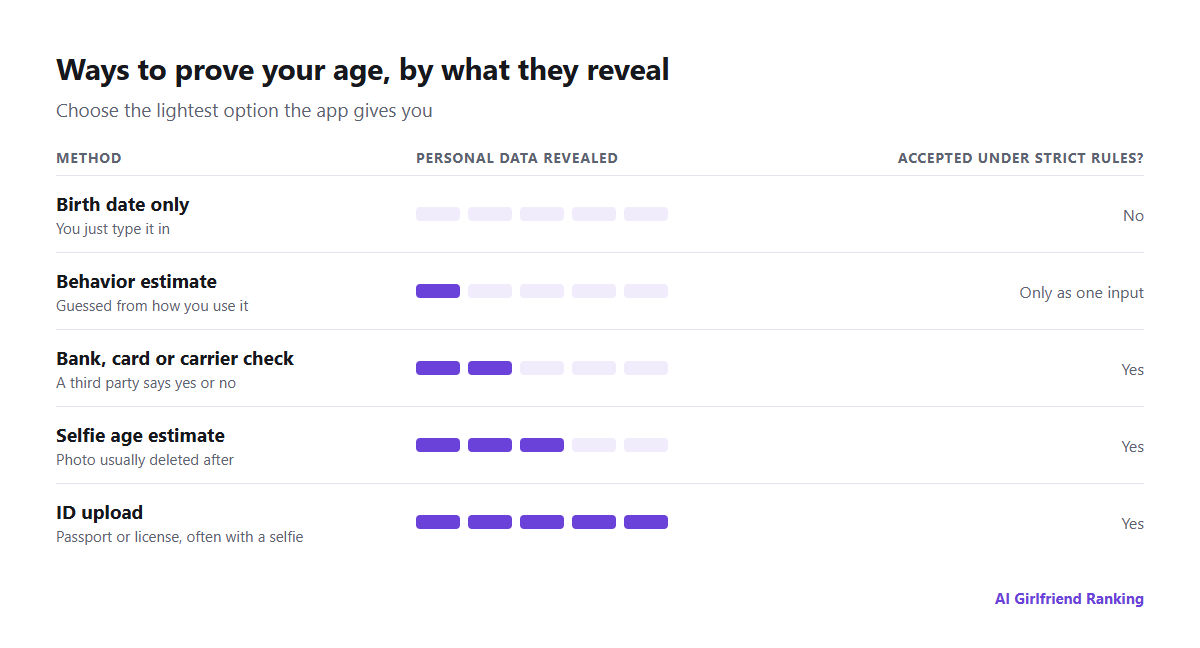
Ordered, give or take, from the least personal data to the most.
| Method | What happens | What the app or checker gets |
|---|---|---|
| Typing a birth date | You enter your date of birth | Nothing it can confirm; regulated markets no longer accept it |
| Behavior-based estimate | The app guesses your age from how you use it | Usage data it already collects |
| Selfie age estimate | Software judges how old your face looks | A photo of your face, which reputable providers usually delete once the check is done |
| Bank, card or carrier check | Your bank or mobile carrier vouches that you are an adult | A simple yes or no from a third party |
| ID upload | A photo of your passport or driver's license, often plus a selfie | The most sensitive data on this list |
| Digital ID or age token | A reusable credential showing you are over 18 | Done well, nothing except the age claim |
Prove your age, keep everything else
- Take the lightest option on the menu. When an app lets you pick between an ID upload and a selfie estimate or a bank check, the ID is almost never the smarter choice.
- Find out who runs the check. A dedicated verification company with a public retention policy is a safer bet than an app keeping a scan of your passport in its own systems. After the leaks we document in our rundown of AI companion data breaches, that difference is anything but academic.
- Read the fine print on retention. The phrase you are hoping to find is some version of "deleted immediately after the check."
- Keep your real-name email out of it where you can. Verification is about your age. Nothing about it requires tying your identity to your chat history.
What changes day to day
- Plan on more age prompts, especially in the UK, in US states with age-verification laws, and any time you turn on adult content.
- Your location can change the feature list. Some apps would rather switch off NSFW content in a market than build the checks it requires. More on that in why some countries block or restrict AI companion apps.
- Be careful on a shared device. An adult account left logged in on a phone or tablet that a kid also uses defeats the entire purpose of the check. Our guide to sharing a device with an AI companion app has the details.
Where age checks go from here
Running an adult-leaning service now more or less requires age assurance. Nobody serious is still arguing about whether apps should check; the fight is over how to do it without opening fresh privacy holes. The strongest candidate is a reusable age token: proof that you are over 18 that says nothing about who you are. Until those tokens are widespread, protect yourself the simple way. Choose the least invasive method you are offered, and favor apps that hand the job to specialist verifiers instead of collecting documents themselves.