Affiliate marketing runs nearly every site in this space. The economics are laid out in how AI companion apps make money, where affiliate payouts turn out to be among an app's biggest expenses. Once you understand the mechanism, you can use reviews for what they do well and discount the rest.
Follow the money
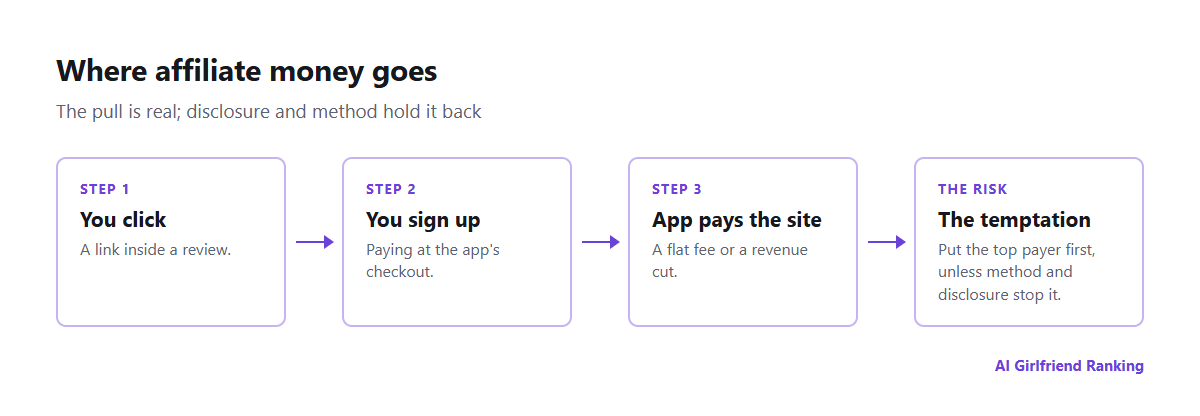
The pull toward bias is real. Disclosure and a fixed method are the counterweight.
- You click a link on a review site and sign up.
- The app sends the site a flat fee or a slice of your subscription, at times for as long as you stay subscribed.
- The better an app pays or converts, the more the site earns from it.
The temptation is plain: put the top payer at number one. What holds it back is disclosure, a published testing method, and the nerve to rank a paying partner low when it tests poorly.
What the law requires
Under the FTC's Endorsement Guides, a site has to disclose material connections, like affiliate commissions, clearly and near the recommendation, not tucked into a footer. On top of that, the FTC's rule on fake reviews, in force since October 2024, prohibits buying or selling fake reviews and undisclosed insider reviews, and it carries civil penalties. Other countries have comparable consumer protection rules.
A site that conceals its commissions is not just unhelpful. It may be breaking the law.
Telling tested reviews from recycled marketing
| A tested review shows | A recycled press release shows |
|---|---|
| Specific moments: "on day nine it brought up..." | Vague claims: "incredible memory" |
| Prices verified on a stated date | Prices lifted from the app's homepage, often stale |
| Screenshots of paid features in action | Marketing images supplied by the app |
| Criticism of the app it recommends | Every app is "perfect for most people" |
| A method page that explains the scoring | Scores that come from nowhere |
| Updates after the app changes | Untouched for years |
| Mentions of privacy incidents involving the app | Total silence on anything bad |
Red flags
- The same top three, in the same order, on site after site. Maybe they really are the best. Maybe they pay the most.
- "Best of" lists for apps the site never reviewed. A twenty-app ranking with no full review behind any of them.
- Zero downsides. Every app in this category has trade-offs.
- Countdown timers and "exclusive" discounts that never actually run out.
- Text that reads the same on multiple sites, which points to shared copy.
Apply the same skepticism to us
The questions above hold for this site too. Our disclosure appears on every page. Our method of paid accounts, two-week tests, five scores, and checks on hidden costs and privacy is published in how we test. We only rank apps we have tested, and a few apps we link to sit near the bottom. When something significant happens after a test, such as a privacy incident, we say so; see AI companion data breaches.
Still, verify. The strongest protection against any review, ours included, is a week of testing on your own. The plan is in how to test an AI girlfriend app yourself.
Five-question checklist
- Is the affiliate link disclosed right by the recommendation?
- Does a method page exist, and does the review follow it?
- Does it give specific, dated details you could only get from using the app?
- Does it find fault with the app it recommends?
- Does it cover privacy and not only features?
Pass all five and a review deserves a careful read, no matter who wrote it. Pass none and you are reading an ad, whatever label it wears.