Most people never mix these two up. Still, they look alike on the surface: affectionate messages, attention whenever you want it, and a request to pay. Scammers have figured out that anyone who uses an AI companion is already comfortable with that combination.
How big romance fraud has gotten
Few scams cost Americans more. In 2023, people told the Federal Trade Commission they lost $1.14 billion to romance scams, and the median loss was $2,000, higher than for any other type of impersonation scam. 2025 went further before the year was even over: more than 55,000 reports and over $1.16 billion in reported losses in just the first nine months.
And that only counts the people who came forward. Police and consumer agencies keep saying most victims never report at all, mainly because they're embarrassed.
The FTC also found that close to 60% of people who lost money to a romance scam in 2025 said it began on social media. The approach was built around whatever their profile gave away, and the ask for money showed up in one of two costumes: a sudden emergency or a friendly tip about an investment platform.
AI erased the old warning signs
Spotting a romance scammer used to be easier. The English was off, a reverse image search turned up the same stock photos, and there was always an excuse for skipping video. AI has wiped out most of those clues.
- Flawless writing in any language. A scammer doesn't need to be a good writer anymore, or to speak your language at all.
- Faces nobody else has. A generated photo never appeared anywhere before, so a reverse image search comes back empty.
- Fake video and voice, live. Face swaps and voice clones now run in real time on ordinary consumer hardware.
- Volume. With a chatbot handling the typing, one operator can keep dozens of believable conversations going at once.
So the classic tip, "just ask them to video chat," proves nothing anymore.
Four red flags: product or con?
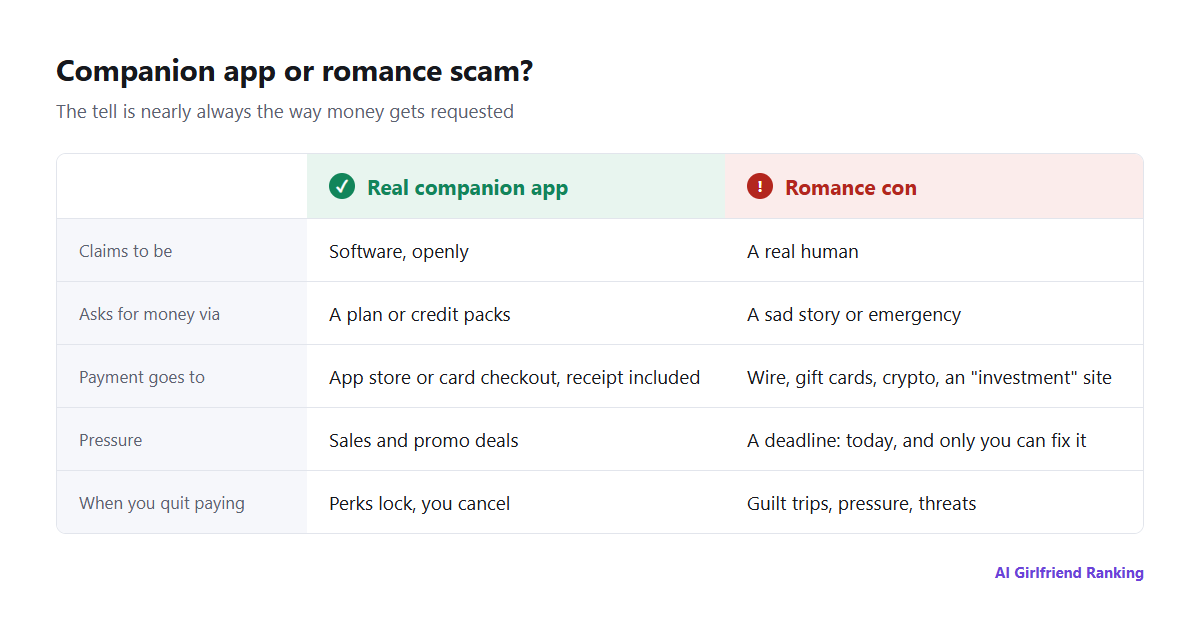
Where a companion product ends and a con begins.
1. It says it's a person. A companion app is upfront that you're chatting with AI, and a growing list of US states now require it to be, as our rundown of US AI companion laws explains. Someone you met online who is always free, always agrees with you and always has a reason not to meet in person is the exact opposite.
2. Payment happens outside a checkout. Real apps bill you through an app store or a card payment page. You get a receipt and a way to cancel. Scammers want wire transfers, gift cards, crypto, or a deposit on some "investment platform" nobody has heard of.
3. An emergency with a clock on it. A medical bill, a customs fee, a frozen bank account, a plane ticket home. It's always urgent, only you can fix it, and it has to happen today. Apps don't act like this. Con artists do.
4. It pulls you off the platform. The chat moves fast to WhatsApp, Telegram or some other private messenger, where no one moderates anything and your earlier conversation history stays behind.
Spot one of these and it's time to walk away. Spot two and you can be nearly sure.
Fraud aimed at people who already use companion apps
Some scams go after existing AI companion users on purpose, since they're known to spend money on digital intimacy.
- Copycat apps. Knockoffs of popular apps with names that are off by a letter or two, listed in app stores or pushed as downloads through ads. Get apps only from the official store listing or the developer's own website.
- "Unlock premium" deals. Bargain lifetime memberships, cracked builds or credit packs sold on Telegram channels and social media. Best case, the money's gone. Worst case, your login is gone too.
- Hijacked accounts. Phishing emails dressed up as billing issues. Whoever takes over your account can read every chat you've ever had. Here's how to lock it down: securing your AI companion account.
- Sextortion. Someone threatens to leak intimate images, real or AI-generated, unless you pay. Whatever you share with an app or in a chat can end up outside it, so read what happens to the images you make and send.
- "AI girlfriend" profiles on social media. Accounts that claim to be an AI or a model and steer you toward a payment link in your DMs. Legit products sell through a website and a checkout page, not through direct messages.
Already paid? Do this now
- Stop paying. That includes the "one final fee to release everything." It's always in the script.
- Call your bank or card company right away. Move quickly and a transfer or card charge can sometimes be stopped or disputed.
- Save all of it: messages, usernames, crypto wallet addresses, receipts. You'll want to delete the conversation. Don't.
- File a report with the FTC at ReportFraud.ftc.gov and with the FBI at ic3.gov if you live in the US. Outside the US, go to your country's national fraud reporting service.
- Don't trust anyone offering to get your money back. "Recovery" services that charge a fee are the second act of the same con, and they go after people who have just reported a loss.
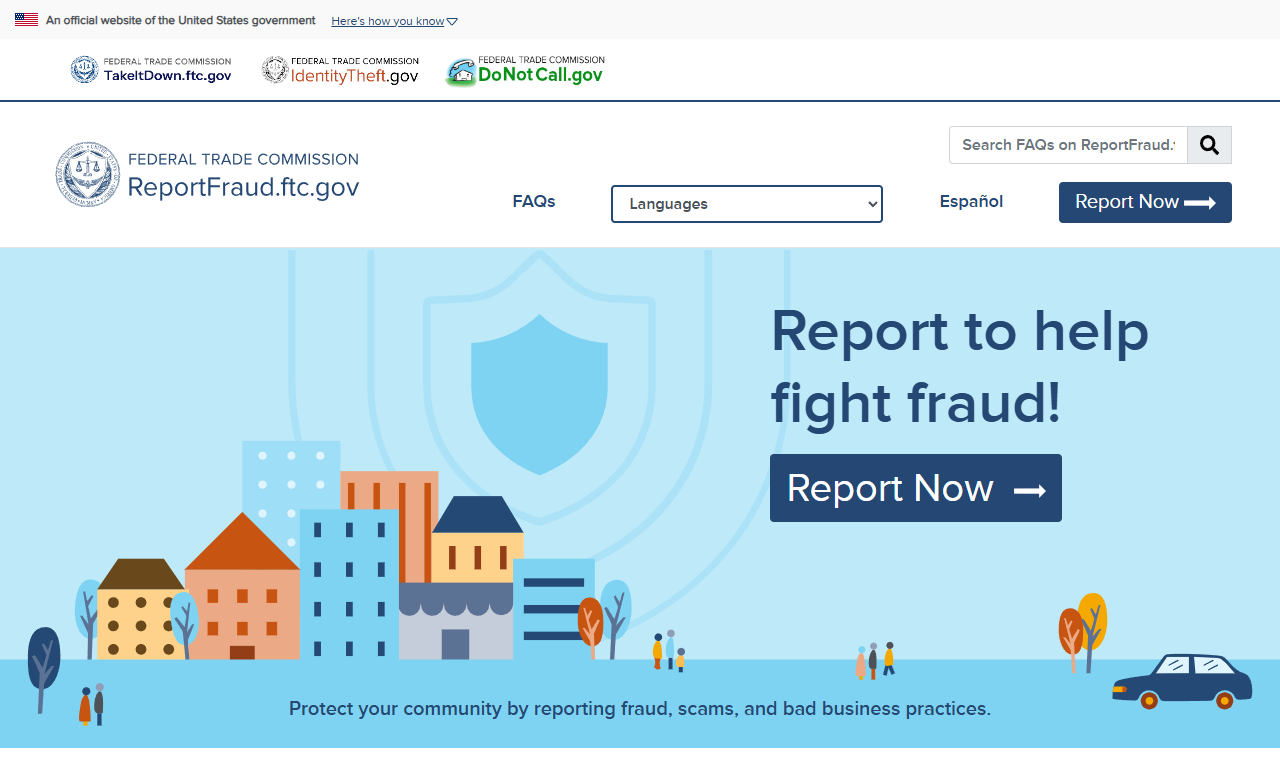
ReportFraud.ftc.gov is where the FTC takes scam reports.
The bottom line
An AI companion can cost too much, push upgrades too hard or let you down, and still be exactly the product it claims to be. A romance scam is fake from the first hello. Money is nearly always the giveaway: a real companion takes payment only through its own checkout. If something wants you to pay any other way, it isn't a companion, whatever name it goes by.