Calling your AI companion is the hardest job she has. In text, a few seconds of waiting goes unnoticed. In speech, people catch lags that would never register in a chat window.
Why 200 milliseconds matters
A study covering conversations in ten languages found that the usual gap between one speaker stopping and the next starting is about 200 milliseconds, and it barely changes from culture to culture. We begin composing our answer before the other person is done. Wait much longer than that and the pause sounds like doubt, confusion or boredom.
To sound natural, an AI must squeeze an entire pipeline into about that much time.
The journey from your voice to hers
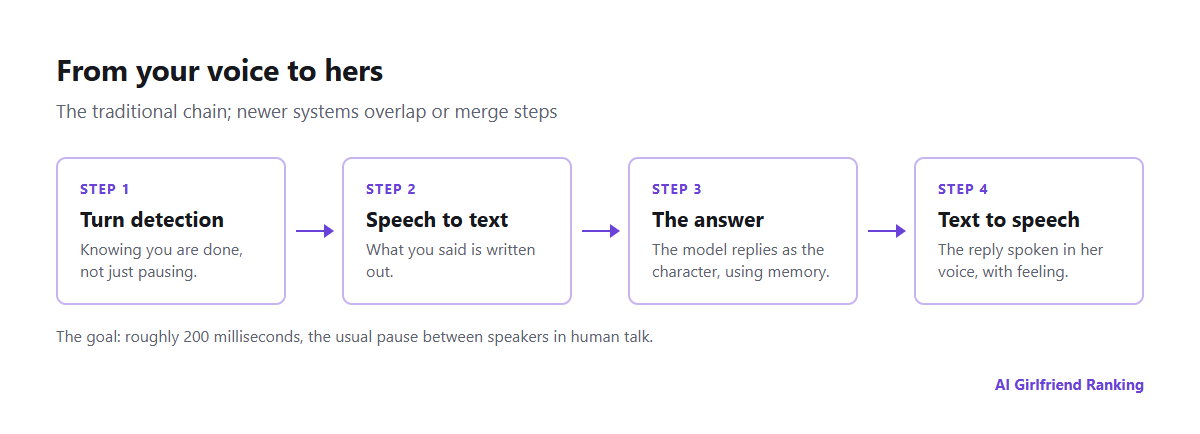
The traditional setup. Newer systems overlap these stages or fold them together.
- Knowing you are done. The app has to tell a finished thought from a mid-sentence breath. Guess too fast and it talks over you. Guess too slow and you sit in silence.
- Speech to text. What you said becomes written words.
- Writing the answer. The language model composes a reply as the character, drawing on memory.
- Text to speech. The written reply becomes audio, ideally in the character's own voice and with feeling.
Older designs make each step wait for the one before it. Newer ones start speaking the opening sentence while the rest is still being written. Others use models that take audio in and give audio out, which skips the transcription and synthesis steps entirely.
The reason for the meter
| Text chat | Voice message | Live call | |
|---|---|---|---|
| How fast it must be | A few seconds is fine | A few seconds is fine | A fraction of a second |
| Added work | Nothing | Speech synthesis | Recognition, synthesis, turn-taking |
| Usual duration | Short replies | A single reply | Minutes, sometimes hours |
| Cost to the app | Lowest | Middle | Highest |
| How it's sold | Bundled in | Bundled or paid with credits | Minutes, tiers or credits |
During a call, the whole pipeline runs nonstop, usually on pricier "real-time" versions of each model. So voice is typically the first feature to get a cap, and "unlimited" almost never covers it. For more on that trap, read how to decode AI girlfriend feature lists.
The ingredients of a convincing call
- Steady low lag. One long pause hurts the illusion more than a slightly slower average does.
- Handling interruptions. If you can cut in and she stops and answers, it's a conversation. If not, you're trading voice notes.
- A consistent voice. Same tone, accent and warmth every time. Our testers noticed that voice quality can differ from one character to the next, even in strong apps.
- Expressive delivery. Laughing, pausing, softening. Real emotion beats text read out loud.
- Memory on the phone. Some apps swap in a lighter model for calls, so the character may know less by voice than by text.
Try it before you pay
- Find out what's covered: voice messages, live calls or both, and the minute allowance.
- Place a two-minute call on a trial or the cheapest plan, over cellular data and over Wi-Fi.
- Cut her off mid-sentence. Does she stop talking?
- Bring up something from your text chats. Does she recall it?
- Look up the price of extra minutes or credits. One long call can burn through a month's allowance.
For the wider picture on what media costs the app, see how AI girlfriend images and voice work. Whether a voice upgrade earns its price is covered in are premium tiers worth it.
Mind your wellbeing
Voice pulls you in harder than text. The 2025 OpenAI and MIT research linked short voice sessions to better wellbeing, while heavy everyday use did not show the same benefit. Use it in small doses, and learn the warning signs in when an AI companion takes more than it gives.