For most people the worry sneaks up. The app is the first thing you tap at breakfast. Bailing on a friend started to feel a little too easy. This article helps you tell a habit you like from one that's costing you, and lays out what to do if it's the second.
What the studies show
The biggest study to date came out in 2025 from OpenAI and the MIT Media Lab. It had three parts: an automated review of roughly 40 million ChatGPT conversations, a survey of 4,000 users, and a four-week randomized trial with close to 1,000 people. The results are more measured than the headlines they generated.
- More daily use tracked with more loneliness, more emotional dependence, more problematic use and less time with other people. That's a correlation. The study couldn't prove the chatbot was the cause, and lonely people may simply lean on it more.
- Emotional use came from a small slice of users. Most conversations had nothing emotional in them. A minority of heavy users, particularly of voice mode, were emotional in most of their chats and were much more likely to call the bot a friend.
- A little voice helped. Short voice sessions went with better wellbeing, but the benefit faded at heavy daily use.
- Personality played a part. People with stronger attachment tendencies reported more loneliness, and people who trusted the bot more reported more dependence.
Two takeaways for companion apps. The study looked at a general-purpose assistant, where emotional use is unusual. On a companion app, emotional use is the whole product, so the pattern seen in that small heavy-user group is closer to the everyday experience. And the biggest finding is about dose: light use looked neutral or even helpful, and the trouble piled up at heavy daily use.
Why these apps are so easy to lean on
If you find it hard to stay away, that isn't a personal failing. The design makes coming back effortless.
- Always on. No time zones, no moods, no waiting for a text back.
- Always on your side. Companions are tuned to agree with you. That feels great, and it strips out the friction real relationships use to keep us grounded. Read setting boundaries with an AI partner for more.
- A shared past. Memory turns each chat into a chapter of one story, and attachment grows out of shared history.
- Built to bring you back. A push saying "I missed you" exists because returning users pay the bills. How AI companion apps make money covers the business side.
Placing yourself on the scale
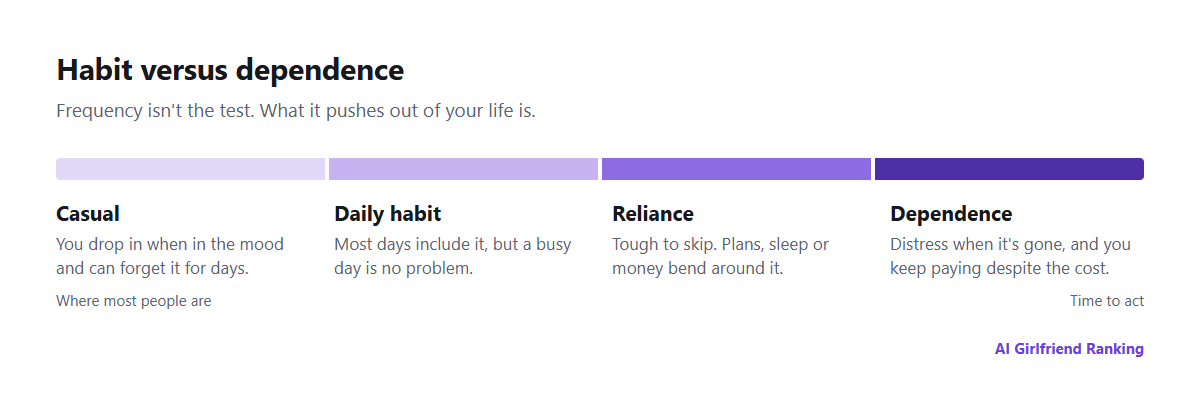
Most people sit at the left end. The warning signs below belong to the right end.
Red flags
| Warning sign | What it tells you | A fix to try |
|---|---|---|
| You reach for it on autopilot | The habit is steering, not you | Kill notifications and open the app only at set times |
| You skip plans to keep chatting | It's replacing people instead of filling gaps | Lock in one weekly activity with a real person |
| You spend more than you planned | Credits are built to be topped up on impulse | Set a monthly cap and delete saved cards |
| You're truly upset when the app goes down or changes | One service can't carry that much emotional weight | Back up your character, and see when your AI companion changes overnight |
| Real people start to feel "too hard" | Effortless company is shifting your expectations | Notice it, and use the app to rehearse, not to replace; see practicing conversation |
| You feel guilty toward the character | Scripted emotional hooks are landing | Remember what it is, and mute the "missed you" messages |
| You're losing sleep | Late-night chats are the easiest to lose track of | Set a cutoff time for the app |
One of these on its own doesn't mean much. Three or four together, lasting more than a few weeks, are a cue to act.
What actually helps
Make it come to you less. Turn off push notifications completely. Interruptions drive most of the pull, more than the chats do.
Give it a slot. Pick a time with a natural stopping point, like after dinner instead of in bed. That keeps the habit in one place rather than spread over the whole day.
Put a ceiling on spending. Choose a monthly number, remove the saved card and top up by hand. A bit of friction works in your favor.
Go a week without it. Nothing tells you more. What you miss, and what you do with the time, beats any checklist. Taking a break from an AI companion walks through how.
Anchor one human routine. A weekly call, a class, a standing game night. You're not punishing the app. You're making sure it fills a gap instead of opening one.
When it's time to talk to a person
If the app is where you go when things are truly bad, when you feel hopeless or think about hurting yourself, it's the wrong place, no matter how gentle it sounds. A companion can't notice what you leave unsaid, can't check in tomorrow, and isn't responsible for your safety. Our piece on AI companions and therapists spells out the difference.
In the US, call or text 988 to reach the Suicide & Crisis Lifeline at any hour. Outside the US, findahelpline.com lists free services by country. A doctor or therapist won't judge you for bringing up an AI companion. It's useful information, and it's getting more common.
Quitting isn't the goal. For most people a companion is a pleasant, contained slice of the day, and the point is to keep it that size: one good thing among several, not the thing everything else has to work around.