I'm not telling you to stay away from a companion when you're feeling low. Plenty of people find real comfort in one. The point is to be clear about what sits on the other side of the screen, so you lean on it for what it does well and look elsewhere for the rest.
What only a therapist can offer
Training and judgment. A therapist learns to spot depression, anxiety, trauma and risk, then picks a method to match. A companion reacts to whatever words you just typed.
Accountability. A licensed clinician is responsible for your wellbeing inside the relationship, reports to a licensing board and can lose the license after serious failures. An app answers to its terms of service.
Pushback that helps. Good therapy means being challenged, gently and at the right moment, on beliefs that are hurting you. Companions are tuned to agree. That feels kind and can quietly strengthen the very thoughts that need questioning. More in setting boundaries with an AI partner.
Memory you can count on. Your therapist recalls what you said three months ago because they took notes and thought it over. A companion's memory is a pile of saved snippets and summaries that can quietly fail or make up details. See why AI companions invent memories.
Privacy with defined rules. Therapy records fall under health privacy law, with set exceptions. Companion chats fall under a privacy policy that may permit staff review, model training and sharing with partners.
The comparison table
| Therapist | Mental-health app | AI companion | |
|---|---|---|---|
| Built for | Treatment | Guided self-help | Companionship and fun |
| Can evaluate or diagnose | Yes | No | No |
| Duty of care | Yes, through licensing | Limited, depends on the law | None |
| What protects your data | Health privacy law | Depends; a few state rules | A privacy policy |
| Challenges your thinking | Yes, on purpose | Sometimes, by design | Seldom |
| Awake at 2 a.m. | No | Yes | Yes |
| Price | Highest | Low | Low to moderate |
| If you're in crisis | Takes action | Points you elsewhere | Points you elsewhere, required by law in several states |
Where a companion earns its place
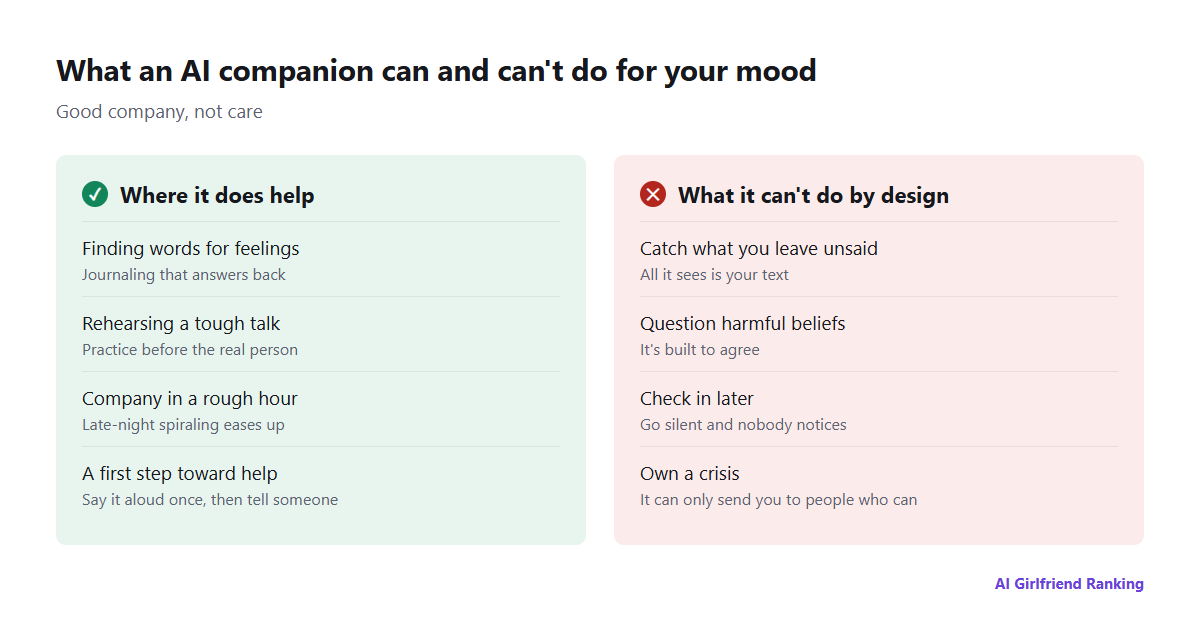
Good company, not care.
- Finding words for a feeling. Talking it through, even with software, often shows you what you really think. Think of journaling that talks back.
- Rehearsing a hard talk. Running through what you'll say to a partner, a parent or your boss is among the best uses of these apps. Try practicing conversation with an AI companion.
- Someone there in a bad hour. Late-night spiraling is easier with something to talk to. That's a real benefit, provided it stays an hour.
- A lower bar for asking for help. Some people say a thing aloud to a companion before telling a human. If that leads somewhere, it counts as a step.
Where it falls short by design
- It can't catch what you skip. A therapist notices the pause, the subject you dodge, how you've changed since last month. A companion gets only your text.
- It goes along with distorted thinking. "Everyone would be better off without me" is precisely the sort of belief an agreeable, warm system may end up validating for the sake of support.
- It never follows up. Vanish for a week and no one checks in. A push notification is a retention tactic, not concern.
- It has no stake in your recovery. A therapist aims to become unnecessary. A companion app's revenue depends on your return. Details in how AI companion apps make money.
Where US law stands
Legislators have begun drawing this boundary in writing.
- Illinois enacted the Wellness and Oversight for Psychological Resources Act in August 2025. Only licensed professionals can provide therapy in the state, AI included. Therapists may use AI for administrative tasks but not for treatment decisions or for talking with clients. Each violation can cost up to $10,000.
- Utah went the other way in May 2025. Mental-health chatbots are permitted, but they must state plainly that they're AI, can't sell users' health data and can't aim ads based on what users type.
- Tennessee prohibits AI systems from posing as licensed mental-health professionals, effective July 2026.
- Companion chatbot laws in New York, California and a growing set of other states make apps detect signs of suicidal thinking and refer users to crisis services. The complete rundown is in AI companion laws in the US.
The pattern is consistent: an AI may keep you company, but in more and more places it can't label what it does as therapy.
When you need a human
See a doctor or therapist if a low mood drags on past a couple of weeks, if it's hitting your sleep, job or relationships, or if you catch yourself needing the companion to get through the day. The warning signs are in when an AI companion starts taking more than it gives.
If you're thinking about hurting yourself, don't wait, and don't count on an app. In the US, call or text 988 to reach the Suicide & Crisis Lifeline. In the UK and Ireland, Samaritans pick up at 116 123. Elsewhere, findahelpline.com lists free services country by country.
988lifeline.org: call or text 988 in the US.
A companion can be one good piece of taking care of yourself. It's a weak replacement for having someone take care of you.