There is a genuine pull to messenger bots. Your AI girlfriend shows up beside your real contacts, notifications just work, and voice notes feel natural. What you give up is any of the oversight that an app store or an established website forces on a service.
Why bots end up in messengers
- No gatekeeper. Apple and Google limit sexual content and vet apps before listing them. A bot in a messenger never goes through that. The store rules are explained in our browser-versus-app breakdown.
- Nearly free to launch. All it takes is a server and a language model. No app has to be built.
- Spread is baked in. Channels, groups and forwarded links do the marketing.
CarynAI, the first influencer AI clone, ran on Telegram in 2023 and billed by the minute. When the company behind it fell apart, subscribers lost it overnight.
WhatsApp pulled the plug
Meta rewrote the terms for the WhatsApp business platform in October 2025, banning general-purpose AI chatbots, meaning bots whose main product is open-ended talk with an AI. The rule kicked in on January 15, 2026. ChatGPT and Perplexity, among other big assistants, left. Customer service, booking and order bots are still fine, and so is Meta's own assistant.
For companion users, that means a WhatsApp number selling an "AI girlfriend" is either breaking the rules and likely to get shut down, or is not an AI service in the first place.
Where Telegram goes wrong
Telegram lets almost anyone run a bot, and that includes some of the most harmful services on the internet. In 2024, Wired turned up at least 50 "nudify" bots that promised explicit images of real people from ordinary photos. Together they listed over 4 million monthly users. Telegram took them down once contacted, and copycats popped up.
Not every companion bot there is like that, yet they share the same weak spots:
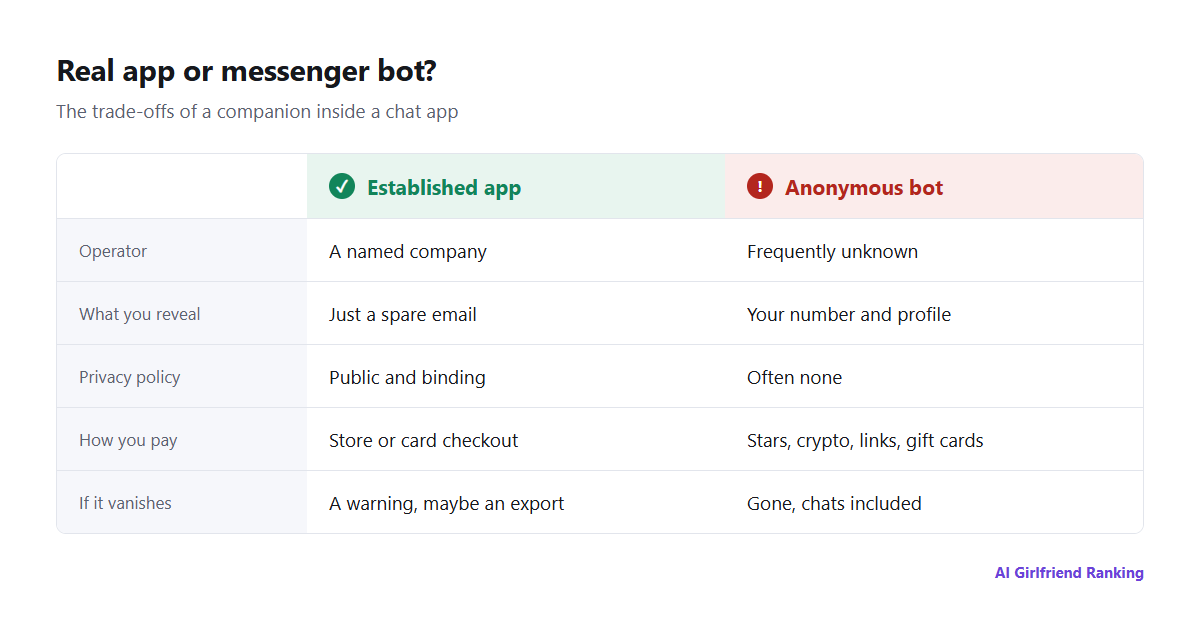
What changes when your companion lives in a chat app.
| Established app | Anonymous bot | |
|---|---|---|
| Operator | A company with a name | Frequently a mystery |
| Privacy policy | Published and binding | Often missing |
| Data deletion | A real process backed by law | Typically no way to ask |
| How you pay | App store or card checkout, with refunds | Stars, crypto, payment links, gift cards |
| Content limits | Filters, age gates, legal obligations | Whatever the owner feels like |
| When it vanishes | A warning, sometimes an export | Gone, and your chats with it |
Specific dangers
- Your phone number is your login. With an app you can sign up using a throwaway email. A messenger bot sees your actual number and profile.
- No end-to-end encryption with a bot. Any AI service has to read your messages to answer them, and ordinary Telegram chats are not end-to-end encrypted to begin with.
- Payments with no checkout. Lots of bots sell credits through links or crypto, which is exactly how scammers collect too. See our piece on romance scams and AI companions.
- Photos of real people. A bot that asks you to upload pictures so it can "look like someone" is offering deepfakes. Making or sharing sexual deepfakes of real people is against the law in many places.
- Overnight disappearance. Bots get banned, dropped or renamed all the time, and your history goes with them.
If you go ahead anyway
- Begin on the company's own website. Never start from a link in a channel or group. A legitimate app with a Telegram bot lists it on its own site.
- Look up the company name and privacy policy before you share anything personal.
- Pay only through official platform methods or a proper checkout. No crypto, no gift cards.
- Do not upload photos of real people. That includes you.
- Stay put. If the bot pushes you toward another messenger or a private link, walk away.
The convenience is real. Still, for most people a companion app or its web version delivers the same chat with an accountable company, a policy you can hold it to, and an exit when you want one.