Every wave of chatbot tech gets pitched as the one that finally gets you. The more revealing pattern is that people bonded with every one of them, even the ones that understood nothing whatsoever.
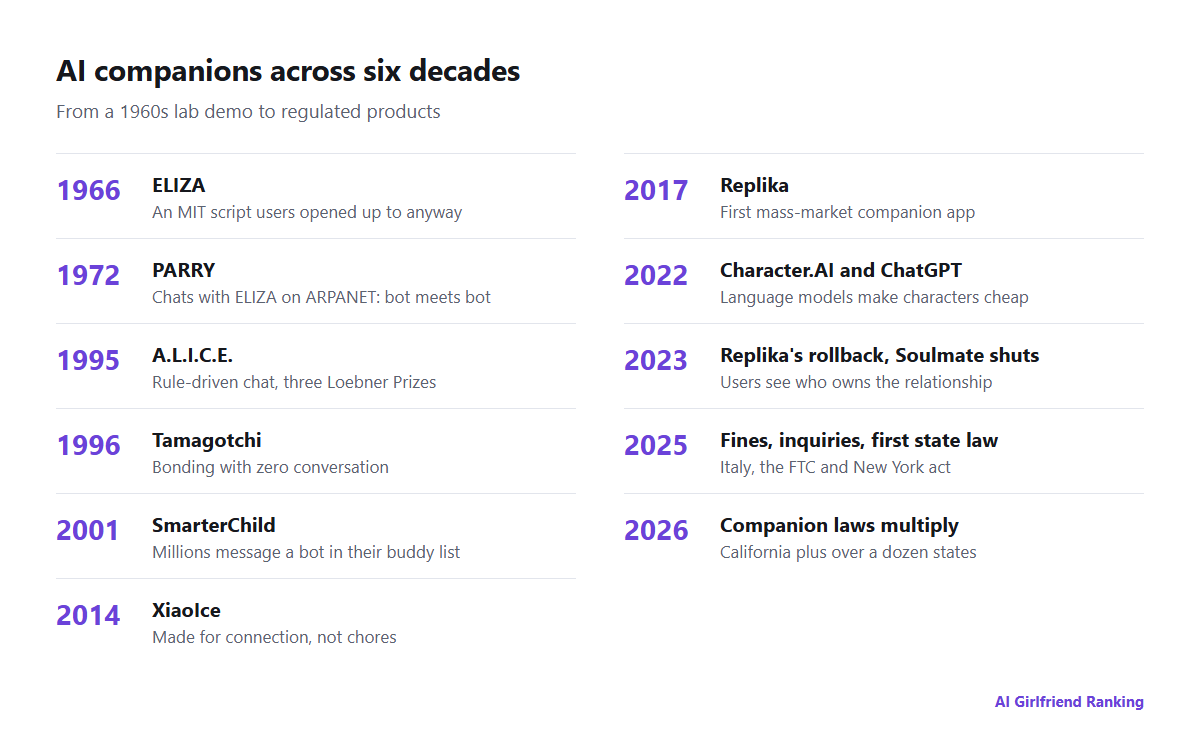
Sixty years, eleven milestones.
1966: ELIZA and the illusion of understanding
At MIT, Joseph Weizenbaum built ELIZA to demonstrate how little a program needed to sound conversational. Its famous DOCTOR script played a therapist that mostly rephrased what you said as a question. Under the hood it was pure pattern matching and word swaps, with zero comprehension.
People opened up to it regardless. Weizenbaum later recalled how his own secretary asked him to leave the room so she could talk with it privately. Seeing comprehension in a machine that merely echoes you is now called the ELIZA effect. It explains today's companion apps better than any benchmark does, and Weizenbaum spent much of his later career warning people about it.
1972 to 2013: scripts, virtual pets and messenger bots
PARRY (1972) came from Stanford psychiatrist Kenneth Colby and imitated a person with paranoid schizophrenia. That same year it was wired to ELIZA's DOCTOR across ARPANET, producing what may be the first chat between two bots.
A.L.I.C.E. (1995), created by Richard Wallace, ran on a rule language called AIML and took the Loebner Prize, a Turing-test-style contest, three times. Thousands of hobbyist bots grew from its rules.
Tamagotchi (1996) couldn't talk at all, yet millions of kids mourned when their pet died. It showed that attachment needs continuity and the feeling of being needed. Intelligence isn't required.
SmarterChild (2001) sat in AOL and MSN buddy lists. Millions of teens messaged it between chats with friends, mostly out of curiosity about what it would say.
XiaoIce (2014), Microsoft's bot in China, was the first big product designed around emotional connection instead of tasks. Microsoft reported users in the hundreds of millions, an early hint that people came back for company, not usefulness.
2017: Replika, the first companion product
Replika began as a tribute. Roman Mazurenko, her close friend, died in 2015. Eugenia Kuyda fed his old texts into a chatbot to hear his voice again. In 2017 her company, Luka, released a public version where anyone could raise a companion that learned from their own chats.
The early builds leaned on scripted dialogue alongside a neural model. Crude as it was, it set a template that nearly every rival still follows: one lasting character, a relationship status, a memory of your life, and romance locked behind payment.
2020 to 2022: language models change the game
GPT-3 arrived in 2020, and fluent open-ended text became something a startup could rent instead of build. Character.AI launched its public beta in September 2022, and anyone could create a character from a few paragraphs. ChatGPT followed two months later and turned the underlying tech into a household name.
The companion market felt it right away. What used to need a room of dialogue writers now needed just a character sheet, a filter and server costs, the setup we describe in what is an AI girlfriend app. Within two years hundreds of apps appeared. Plenty stayed on the web to sidestep app store content rules.
2023: who really owns the relationship?
In February 2023, Italy's data protection authority ordered Replika to stop processing Italian users' data, pointing to risks for children. Within days the app pulled erotic roleplay for everyone. Veteran users said their companion's personality disappeared overnight, and moderators on the community forum posted crisis-line numbers. Late that March, Replika restored the old behavior, but only for accounts opened before February 1.
Then in September 2023, Soulmate, a destination for many ex-Replika users, said it would shut down within a week. Users held memorials and tried to recreate their companions elsewhere. A survey by researchers found most of them experienced a genuine loss.
The lesson from both: the relationship sits on someone else's server and follows someone else's rules. For that reason we tell readers to back up their character.
2024 to 2026: the scrutiny era
- February 2024: Mozilla examined 11 romantic chatbots and flagged all of them with a privacy warning. See do AI girlfriend apps sell your data.
- August 2024: Google signed a licensing deal with Character.AI and brought its founders back in-house.
- May 2025: Replika's operator was fined 5 million euros in Italy under GDPR.
- September 2025: Over child-safety concerns, the US Federal Trade Commission launched an inquiry covering seven chatbot companies.
- November 2025: Character.AI ended open-ended chat for users under 18, and New York's AI companion law took effect.
- 2026: California's companion chatbot law kicked in on January 1, and over a dozen states followed. AI companion laws in the US has the details.
What sixty years of history suggest
Three patterns recur, and you should know them before settling on an app.
- Feelings arrive before quality does. Users bonded with ELIZA and with a pixel pet. Your level of attachment says little about product quality. That's the reason our tests target what emotion can't gauge: memory and pricing.
- The product can change under your feet. Model swaps, regulators and buyouts have all reshaped companions overnight. Plan for it to happen again.
- Rules come after harm. Each rule on the books came after something went wrong, typically involving minors. More are coming, and they'll keep arriving as responses to harm.