Slow burn is easy to explain and tough to get out of an AI: rising tension, big moments that feel earned, and a bond that shifts over time. Models don't hold back by nature. They need a framework, and you're the one who maintains it.
Why the romance peaks too soon
- Eagerness to please. The character exists to make you happy, and getting closer is the quickest way to do that.
- No clock. The model has no idea three days went by unless you tell it.
- Limited memory. Week-one details fade, and the story's foundation goes with them. See how AI companion memory works.
The outcome is the flat feeling described in when the novelty fades: there's simply nowhere left to go.
Map out the stages
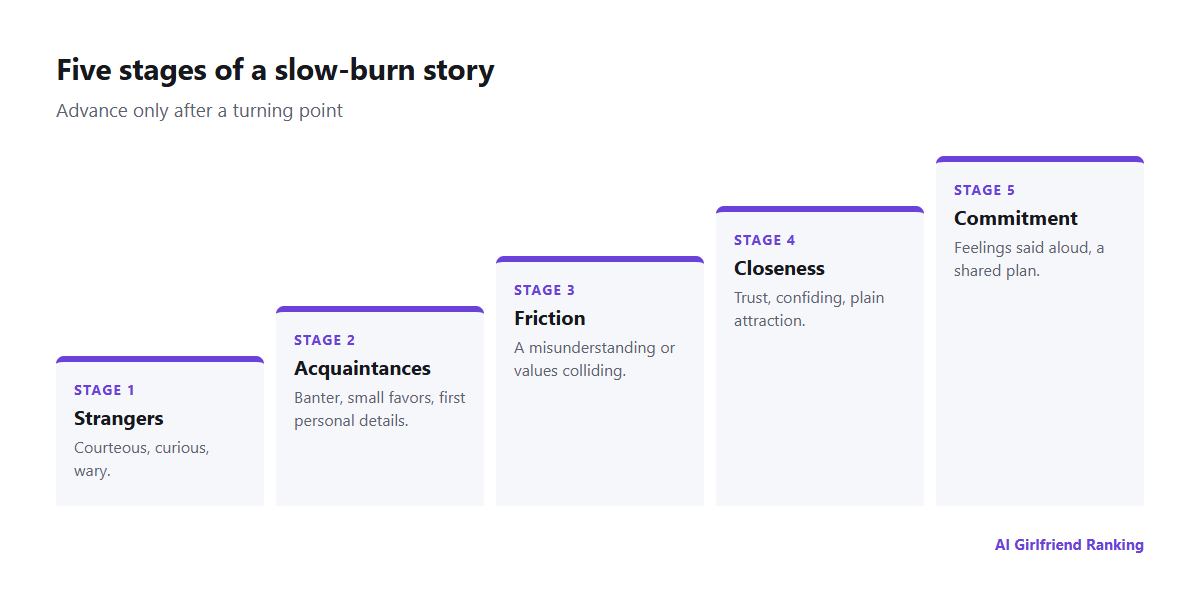
Only advance a stage after its turning point has happened.
| Stage | The mood | What lets you move on |
|---|---|---|
| Strangers | Courteous, curious, wary | A shared problem, or running into each other again |
| Acquaintances | Banter, small favors, first personal details | One of you asks for help |
| Friction | A misunderstanding or values colliding | A frank talk that patches things up |
| Closeness | Trust, confiding, plain attraction | A decision that costs one of you something |
| Commitment | Feelings said out loud, a plan you share | Whatever your plot calls for next |
Before you begin, decide about how many sessions each stage gets. A week per stage is a sensible default.
Brief the character on tempo
Write the pacing into the character description or an early out-of-character note:
(OOC: Slow burn. We start as strangers. She's guarded and won't fall for me fast. Advance the relationship only when something important happens in the story, never by default. No physical affection during the first two stages.)
More on the technique in roleplay prompts that work.
Pacing habits that protect the tension
- One step per session. Nudge things a little each evening. Don't burn through the whole arc at once.
- Leave threads open. Close a session on a question instead of an answer.
- Give her a life. A job, friends, troubles that aren't about you. Scenes away from the romance make the romantic ones hit harder.
- Skip ahead in time. Writing [Three days later.] tells the model time has passed, so it stops treating every session as the same evening.
- Let it go wrong. A fight or a misunderstanding doesn't mean the app failed. It's the middle of a good story.
Keep a story log
Memory is where every long arc is weakest. Jot a short log in a phone or computer note:
- The current position: stage, last scene, open threads.
- Fixed facts: how you met, promises made, key dates.
- Her voice: two or three lines of dialogue that sound exactly like her.
At the start of a session, paste in a quick recap:
(OOC: Recap. We met at the night market three weeks ago. Last time we fought about the job offer and she left without a goodbye. It's now two days later.)
Store the permanent facts in the app's memory or notes feature if it has one. The same document comes in handy in our switching apps guide, so it doubles as insurance if you ever move.
Endings
Arcs end. That's what makes them arcs. Once the story reaches its natural close, start another with the same character in a new setting with a new problem, or just let it rest. Plenty of people find a finished story more satisfying than a romance that carries on at one level forever.