One companion can feel flat in one chat and vivid in the next, and the gap almost always comes down to your first two messages. That is what this guide covers.
Why openers miss
A language model guesses what comes next from everything already in the chat. The process is laid out in how an AI companion writes its reply. Three habits follow from that.
- It matches your length. Send one line and you get a short answer. Send a paragraph and you get one back.
- It matches your style. Write in the present tense with small physical details and it will too. Type "hey wanna rp" and it will answer in kind.
- It defaults to the most typical choice. Leave out where and when, and it grabs the most common setting from its training data. That is why so many scenes open in a coffee shop.
So there is no magic phrase. What works is giving the model enough story to keep going.
Four ingredients for a scene
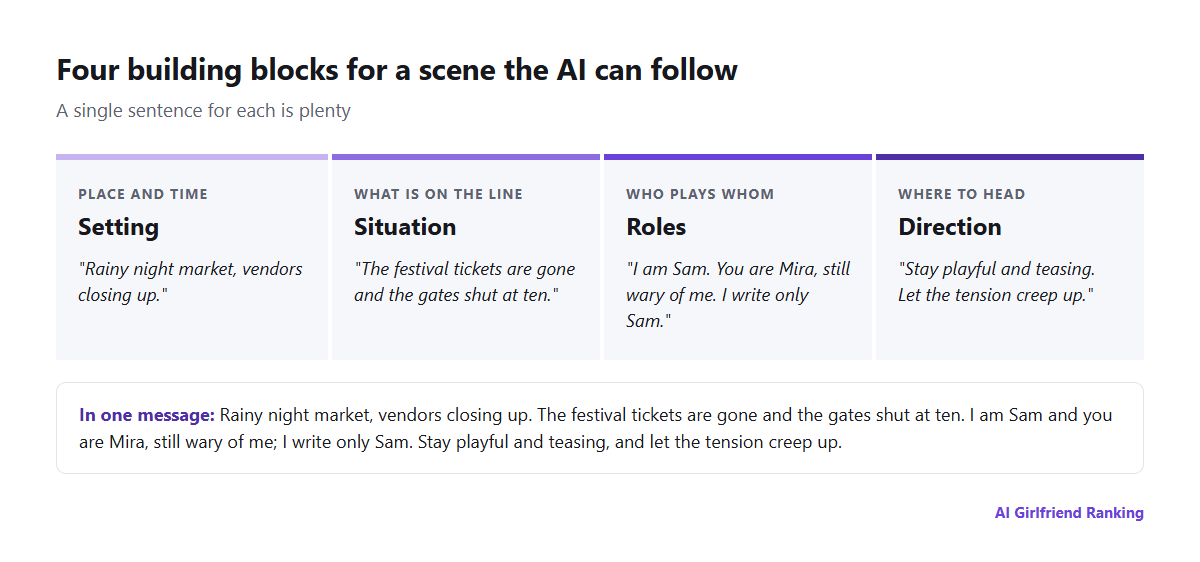
A scene the model can follow needs all four, and a single sentence for each does the job.
Setting. Where and when, with a detail or two. Skip "a city" and go for "a night market in the rain, stalls packing up."
Situation. What just happened, or what is on the line. Every scene needs a reason to exist.
Roles. Who you are, who the character is right now, and what each of you knows. This is also the spot to say you play only your own character.
Direction. Where you want it to go: mood, pace, destination, and any limits.
Side by side: flat and strong
| Flat | Strong |
|---|---|
| "Let's go on a date." | "It is Friday night at the little Italian spot you picked for its calm. Calm it is not: a birthday crowd is singing two tables over. I walk in ten minutes behind schedule, dripping wet. Sorry, the bus died on me. You look great, though." |
| "Be my girlfriend on a trip." | "We are three days into a drive up the coast. An hour back the car's AC gave out, and we have been trading mock-serious blame for the whole idea. I steer into a gas station. You are you, I am only me. Playful, teasing tone please." |
| "Fantasy roleplay please." | "Evening in a frontier town, one day before the festival. You are the healer who bandaged me at dawn, and I am a broke courier. You are still deciding if I can be trusted. Go slow and let the tension grow over a few scenes." |
The strong versions are not longer just to be longer. Each one answers all four questions and finishes on something the character can react to.
Steering mid-scene
Out-of-character notes. Almost any model treats a short bracketed aside as talk to the author, not the character: (OOC: slow down, more dialogue, less description.) Keep these short and tack them onto the end of your message.
Time skips. Something like [Two hours later, back at the apartment.] gets a stuck scene moving faster than asking the character to switch topics.
Regenerate or edit. When a reply misses the mark, regenerate or edit it instead of debating it in chat. Anything left in the history becomes a pattern the model copies later.
Say what you want, not what you do not. "She answers in short, dry sentences" beats "don't be so wordy." Naming the unwanted thing puts it into the text the model is continuing.
One instruction per message. Pile on ten rules and they blur into none. Handle the biggest problem, then move to the next.
Holding a long scene together
Given enough length, a roleplay passes what the model can reread every turn, and early details slip away. That is the same limit covered in how AI companion memory works. Two habits help:
- Recap now and then. A three-line OOC summary of where you are, what happened and what matters puts the essentials back in front of the model.
- Use the memory or notes field for facts that cannot drift: names, relationships, injuries, promises.
If the character contradicts itself anyway, it is not ignoring you. It made up a detail to fill a gap. See why AI companions invent memories. Fix it with one line and carry on.
How the character sheet fits in
Scene prompts sit on top of the character's permanent description. If one problem shows up in every scene, such as too formal, too eager, or always the same pet name, fix it in the character, not scene by scene. Our character builder guide covers which fields matter.
And when a scene halts with a refusal, the cause is the app's filter, not your prompt. What each kind of filter does, and why even permissive apps keep a floor, is explained in content filters.