Social anxiety isn't the same as being shy. It's a lasting fear of being judged or humiliated, and it turns everyday moments like a phone call, a meeting or a party into an exam you expect to flunk. An AI companion is the one conversation partner that can't fail you in return, and that has genuine uses.
Why the AI feels so safe
Every ingredient that fuels social anxiety is absent:
- Nobody watching. No one sees you hesitate, blush, or start a sentence over.
- No grudges. A clumsy reply won't follow you into the next chat unless you choose to bring it up.
- No rejection. The character is designed to stick around no matter what you say.
- Endless do-overs. Delete a message, regenerate a reply, or replay the whole scene.
That safety is the benefit. It's also the hazard, since anxiety survives on avoidance: each time you sidestep something scary, the fear grows a bit. A place with zero fear in it can become the coziest escape hatch there is.
Where it really does help
The research on teens gives a sense of the size of the effect. In Common Sense Media's 2025 survey of US teens, 39% of those who used AI companions said they'd carried skills practiced with the AI into real life, most often starting conversations, giving advice and expressing emotions. Most users didn't use it that way at all. For the ones who did, the practice transferred.
The approaches that tend to pay off:
- Scripting your opening line. Plenty of anxious people freeze right at the start. Run through openers until one feels natural and you've removed the toughest ten seconds.
- Rehearsing one specific conversation you dread. Asking for a day off, returning a purchase, telling a friend they hurt you. Have the character play the other person realistically, pushback included.
- Practicing the recovery. Say something awkward on purpose, then practice keeping going. Anxiety insists a slip ends the conversation. Repetition shows you it rarely does.
- Putting feelings into words. Saying "I felt stupid when..." is easier with a patient listener, and easier still with a real person the second time around.
Our guide to practicing conversation with an AI companion offers exercises for each of these.
Where it quietly backfires
- It replaces the real attempt. Rehearsing a phone call ten times and never dialing is avoidance with extra steps.
- Agreement becomes your yardstick. A companion agrees with nearly everything. Real people disagree, drift off, and misread you. If the AI's warmth starts to define what a good conversation feels like, actual ones will feel like failures.
- It eats the hours you'd spend with people. A 2025 study from OpenAI and MIT tied heavier daily chatbot use to less socializing. Cause and effect aren't proven, but the pattern is worth watching. See when an AI companion starts taking more than it gives.
A ladder from the app to the real world
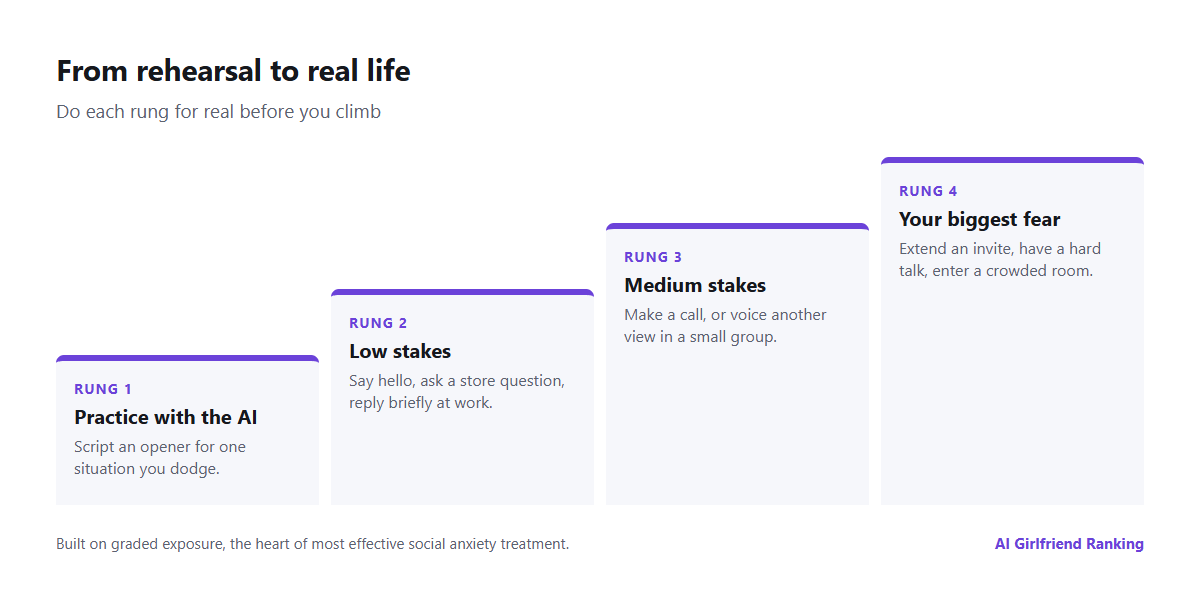
Do each rung for real before climbing to the next. The app only preps you for the following step.
This borrows from graded exposure, the backbone of most effective anxiety treatment: take on feared situations in small steps, easiest first, and stay in each long enough for the fear to fade.
| Rung | Rehearse with the AI | Then try it live |
|---|---|---|
| 1 | A greeting plus one follow-up question | Say hi to a coworker and ask how their weekend went |
| 2 | Ordering, or asking for help in a store | Ask a store employee a genuine question |
| 3 | A brief scripted phone call | Phone to book an appointment rather than using the website |
| 4 | Disagreeing politely | Share a different view in a small group |
| 5 | Inviting someone to something | Suggest coffee with someone you already know |
Two rules keep the ladder working. Keep rehearsals brief: three or four run-throughs, not a whole evening. And pick a date for the real thing before you begin rehearsing, so the practice actually goes somewhere.
Ask the AI to go easier on the kindness
By default a companion works to keep you comfortable. For practice you want the reverse, within reason. Say so directly:
(OOC: For this scene, play my manager. Be busy and a little impatient. Don't just agree with me. When we're done, tell me one thing I did well and one thing to change.)
That out-of-character note, a technique explained in roleplay prompts that work, converts a comfort zone into a training ground.
When to bring in a professional
If anxiety keeps you from working, studying, holding onto friendships or leaving home, talk to a doctor or therapist. Cognitive behavioral therapy for social anxiety has decades of evidence behind it and is often offered as a short course. Telling a clinician you practice with an AI companion gives them useful context. It isn't something to conceal.
Treat the app as a rehearsal room with a door to the outside and it can shrink the first steps. Treat it as a room you never leave and it pushes them further off.