Each step past plain text adds presence: first a voice, then a face, then a body in your space, and eventually touch. Each step also adds cost, complexity and data collection. Here's how each one looks in 2026.
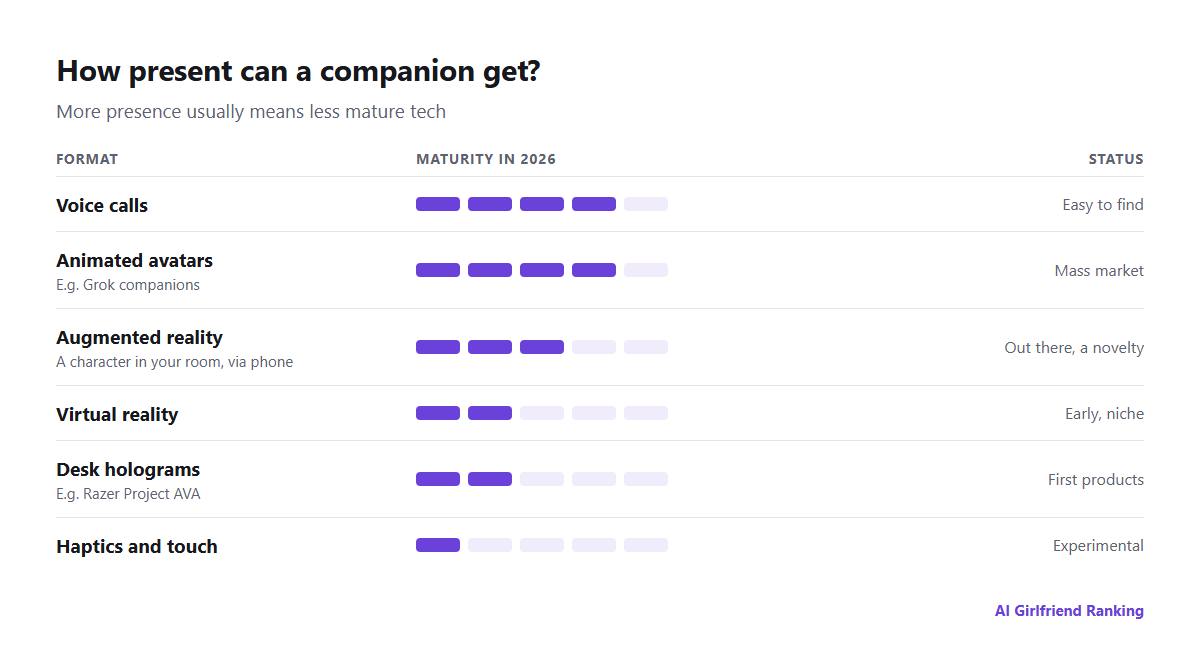
Moving right means more presence and less mature technology.
Animated avatars
This is the most common step past text. A 2D or 3D character on your phone or computer moves, changes expressions and syncs its lips to its voice. In July 2025 xAI put animated companions into its Grok app, among them an anime-style female character and a cartoon red panda, complete with voice and an "affection" system that unlocks new behavior as the relationship level goes up. It brought avatars to a mass audience, along with an argument over what those unlocks contained.
Status: mature and easy to get.
Augmented reality
AR drops the character into your actual room through your phone's camera. Replika has had an AR mode for years. Most people treat it as a novelty that's fun for a few minutes, but it hints at where things are heading: a character that shares your space instead of living behind glass.
Status: available, but mostly a novelty on phones.
Virtual reality
Put on a headset and you can sit across a table from a character, take a walk with her, or share a virtual room. A number of VR apps and social platforms host conversational AI characters. The obstacles are practical: headsets get heavy over long sessions, character bodies move stiffly, and there's little to do together besides talk.
Status: real, yet early and niche.
Holograms and desk gadgets
Here the character lives in a small device on your desk and shows up without any headset. Japan's Gatebox has sold a hologram-style character device since the late 2010s, pitched as a companion who greets you when you get home. At CES in January 2026, Razer showed Project AVA: a 5.5-inch animated hologram in a cylinder, with a camera, microphones and a choice of characters, running on xAI's Grok at launch and slated to ship in the second half of 2026.
Status: first-generation products; expect prices and features to shift.
Haptics and touch
Touch is the toughest problem. Haptic vests, gloves and connected gadgets can deliver pressure or vibration, and some adult devices can be driven by an app or a chat. None of it comes close to convincing physical presence. It's a hint of touch, not the sensation of a person.
Status: experimental, with a small niche in adult devices.
What a home device records
| Chat app on your phone | Companion device at home | |
|---|---|---|
| Microphone | Only when you turn it on | Often listening for a wake word all day |
| Camera | Seldom used | Frequently built in for eye contact and gestures |
| Place in your life | A screen you pick up | Something that sits in your room |
| What it can pick up | What you type | Your voice, face, routines and surroundings |
| How to turn it off | Close the app | Look for a hardware mute and a camera shutter |
Before you buy anything with a camera and a microphone, learn what happens on the device versus on servers, whether a physical mute exists, how long recordings are stored, and whether you can erase them. The questions in what your AI girlfriend app knows about you count double here.
Where this is heading
The direction is obvious: more presence, mainly through voice and animated avatars, pushed by big companies, as covered in what Big Tech is doing with AI companions. Voice is where the genuine progress is happening now; see AI companion voice calls. Headsets and holograms will get better, but in 2026 the most immersive option for most people is still a good voice call with a character who remembers them.