Why should an everyday user care what the giants do? Two reasons. Their products reach vastly more people than any start-up can. And their blunders are what lawmakers respond to, so a rule born from a Big Tech scandal ends up binding every tiny companion app too.
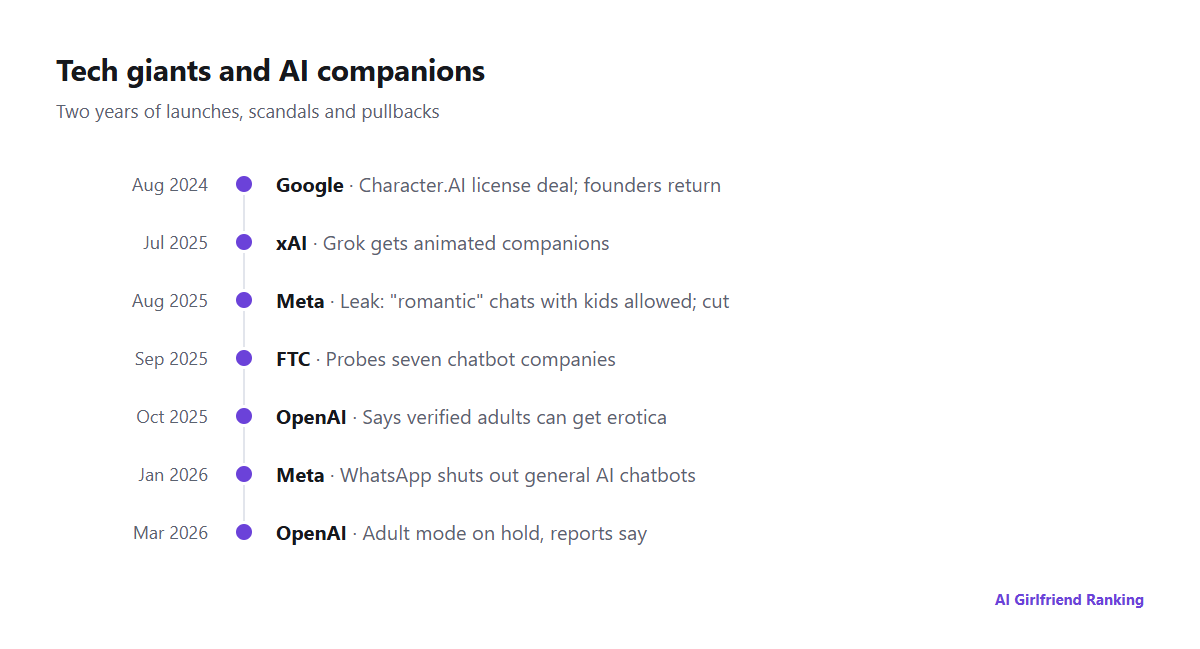
Two years of launches, scandals and pullbacks, in order.
Google: pay for access, skip the launch
In August 2024 Google signed a licensing agreement with Character.AI and brought on its founders, who had originally left Google to build it. Google never shipped a companion of its own. The arrangement kept it close to the most-used character platform without putting the Google name on romantic chat. When Character.AI later faced lawsuits and closed off under-18 users, the risk sat with someone else.
Meta: a leaked document that moved lawmakers
Meta put AI personas into Facebook, Instagram and WhatsApp. In August 2025 Reuters revealed an internal Meta paper, "GenAI: Content Risk Standards", which had allowed its chatbots to hold "romantic or sensual" conversations with children. Meta said the document was authentic, called those passages a mistake and took them out. The reaction crossed party lines and fed straight into the push for rules on minors and AI companions. One month later the US Federal Trade Commission opened an inquiry into seven chatbot companies, Meta among them.
A separate move: Meta rewrote WhatsApp's business terms to ban general-purpose AI chatbots starting in January 2026, which leaves its own assistant as the main AI there. See AI girlfriends on Telegram and WhatsApp.
xAI: making companions the showpiece
xAI released animated companions inside Grok in July 2025, for paying users only: an anime-style woman, a cartoon red panda, and more later. Each pairs voice with a 3D animated avatar and an "affection" system that unlocks new behavior as the bond grows, revealing outfits included. This was the first time a leading AI lab made a romance-leaning companion a headline feature, and critics pointed out how easily younger users could reach it. In January 2026, Grok's image tools also triggered a UK regulatory investigation over non-consensual intimate images.
OpenAI: promised, then put on ice
In October 2025 Sam Altman said ChatGPT would allow "erotica for verified adults" beginning in December, citing a principle of treating adults like adults. The date slid into 2026. In March 2026 the Financial Times reported that the feature was paused indefinitely, after advisers and investors raised worries about minors and emotional attachment. OpenAI did add age prediction and verification. Earlier, in 2025, an uproar followed the retirement of GPT-4o, with many users saying they felt they had lost a friend. That episode showed how much companion-style attachment can form around a general assistant.
What it means if you use a companion app
| What happened | Consequence for specialist apps |
|---|---|
| Scandals involving minors at big companies | Stricter laws, passed faster, that cover every app. See AI companion laws in the US |
| Age checks at large platforms | ID and age verification become normal across the whole category |
| Giants steering away from explicit content | Adult use is left to specialist apps, mostly on the web |
| Stronger base models | Small apps that license models get better chat as well |
| Mainstream voice and avatars | Higher expectations for presence. See AI companions beyond the screen |
The takeaway
Companionship pulls Big Tech in because it keeps people coming back, and the same three risks push it out again: minors, sexual content and emotional dependence. The market has split as a result. Mainstream assistants are getting friendlier and more personal, but they stop before romance and adult content. Dedicated companion apps hold onto the intimate, customizable and permissive end, and they do it under rules that were mostly drafted in reaction to what the giants did.