Here's the honest bottom line. Right after a chat, people feel less lonely. A small group of heavy users seems to do worse. Beyond that, the long run is nearly unexplored. The fine print beats both headlines.
Four key studies
| Study | Method | Headline result | Biggest weakness |
|---|---|---|---|
| Maples et al., Stanford (2024) | Questionnaire sent to 1,006 students on Replika | Compared with most students they were lonelier, yet many found the app useful. Unprompted, 3% wrote that it had ended suicidal thinking | Self-reported, nobody to compare against |
| De Freitas et al. (2024, published 2026) | Several experiments, including one over a week | A single session eased loneliness on par with a chat with a human; the sense of being heard drove most of it | Only short-lived effects |
| OpenAI and MIT Media Lab (2025) | Around 40 million conversations analyzed, 4,000 survey respondents, about 1,000 people in a four-week trial | Those using it most each day were lonelier, more dependent and less social | A correlation, involving a general chatbot instead of a companion app |
| Common Sense Media (2025) | Poll of 1,060 American teenagers | 72% had tried AI companions; among them, 39% brought social skills into everyday life | Self-reported, and teens alone |
What the data backs up
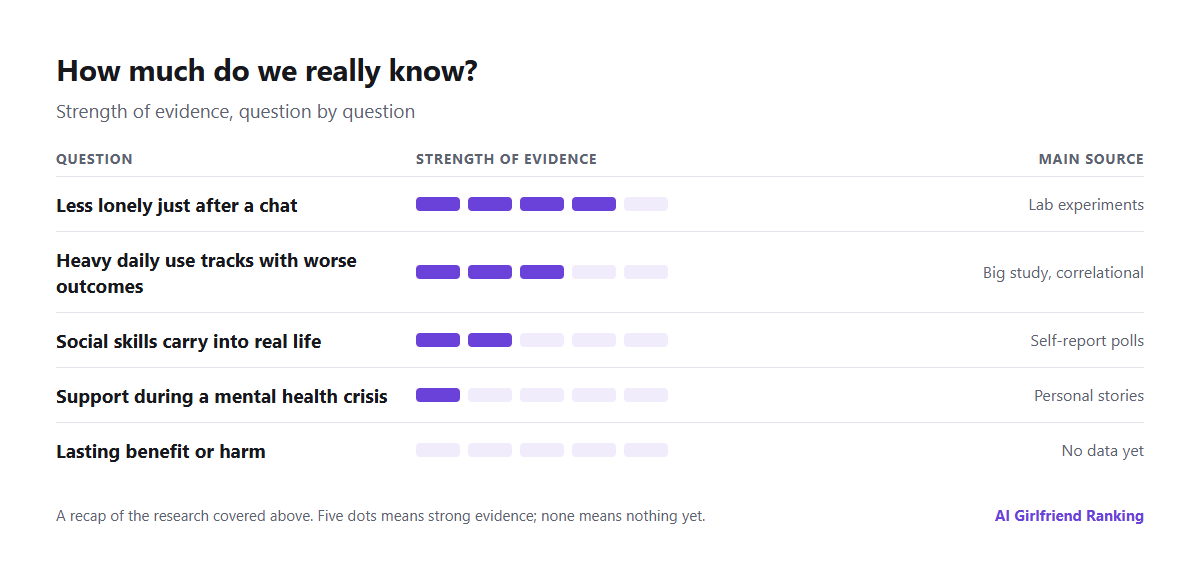
The short-term lift is real. Julian De Freitas and his colleagues ran the best experiments. After time with an AI companion, participants were less lonely, on par with a conversation with another human and better off than after watching videos. They also underestimated the benefit beforehand. Feeling heard was the ingredient that counted.
Some users describe life-changing benefits. Among the 1,006 students in the Stanford Replika survey, 30 (3%) offered on their own that the app had put a stop to suicidal thoughts. That's a striking number, but it comes from free-text answers, not a measured outcome. It tells us some people credit the app. It doesn't prove the app was the cause.
Practice can carry over. Among teens who used AI companions, 39% reported taking skills they'd rehearsed with the AI into real situations.
What the data cautions against
Amount seems to matter. The OpenAI and MIT research tied heavier daily use, of any kind, to greater loneliness, deeper emotional dependence and fewer hours with other people. Brief voice sessions went along with better wellbeing, and heavy use did not.
A small slice holds most of the risk. Emotional use was concentrated in a minority of heavy users, far likelier to call the chatbot a friend. Emotional use is the whole point of companion apps, so the group there is probably larger.
Personality plays a role. Loneliness was higher among people prone to strong attachment, and dependence was higher among those who trusted the chatbot most.
How much we know, question by question.
The big unknowns
- Years of use. No study has tracked companion users over years. Whether brief relief adds up to lasting wellbeing, or dependence wears it down, is an open question.
- Which way the arrow points. It could be that people who are already lonely just use companions more. The data so far can't separate the two.
- At-risk groups. Almost no controlled research includes minors or people with serious mental illness. That gap helps explain why a number of US states now put rules on companion apps for young users. See AI companion laws in the US.
How to read a study like this
- Find out who ran it. OpenAI co-ran the biggest chatbot-use study. That doesn't invalidate it, and the results weren't flattering to the company, but you should know.
- Match the product. Results about ChatGPT, a general-purpose assistant, don't automatically apply to companion apps designed for closeness, and vice versa.
- Mind the time frame. A claim about one afternoon isn't a claim about twelve months.
- Look at how it was measured. Users saying it helped is weaker proof than a measured result that beat a control group.
The takeaway for you
The evidence points to a middle path. A companion can bring real comfort, especially in lonely stretches, and brief regular sessions look fine for most people. Problems appear with heavy daily use, above all once it begins crowding people out. The signs are laid out in when an AI companion starts taking more than it gives.
Past ordinary loneliness, whether that's a low mood that won't lift, anxiety that shrinks your life or thoughts of self-harm, nothing in the research backs using a companion instead of care. An AI companion is not a therapist spells out why. In the US, 988 takes calls and texts around the clock.