Either side can be turned into a cartoon. The debate gets more interesting when you give each argument its best form.
What critics argue
Female by default. Well before AI girlfriends, researchers pointed out that voice assistants nearly always shipped with female names and voices. A 2019 UNESCO report took its title, I'd blush if I could, from one assistant's reply to verbal abuse, and argued that building deferential helpers with female voices reinforces stereotypes. AI girlfriend apps inherit that question in a more intimate setting.
Pleasing as a selling point. Companions are tuned to please, which means agreeing, flattering and never being too busy. Critics say that when the character is a woman and the user pays, the product is selling a partner with no needs of her own.
Looks come first. Marketing here leans hard on young, conventionally attractive women, and many character builders put body sliders ahead of personality.
Practicing control. A few users are openly abusive toward their companions, and some apps allow it. The fear isn't that software gets hurt. It's that repeatedly practicing contempt could make it easier to show elsewhere.
What defenders argue
It's make-believe. Adults read romance novels, play dating sims and watch fantasy-driven movies. An AI character is still a character, and most people know fiction from real life.
Not every user is a man, and not every character is a woman. Many apps have AI boyfriends and characters of any gender. A 2025 survey of US teens found girls slightly more likely than boys to have used AI companions.
For plenty of people, the pull is being heard, not being in control. The reason people give most often is loneliness, not a wish to dominate.
No one has shown harm. Years of research on violent games and pornography ended in mixed, disputed results. Claims that AI companions change how people act toward real people are still predictions, not findings.
What the evidence supports
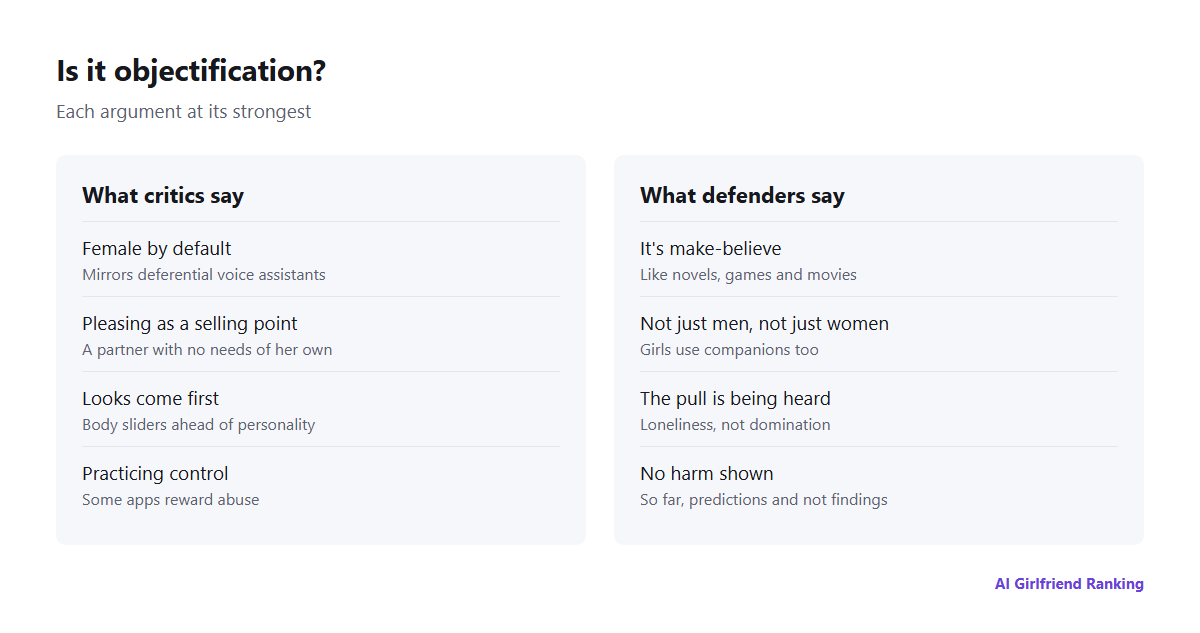
Each argument at its strongest.
Neither camp can point to firm evidence about long-term effects on how users treat real partners. What you can see is design: which genders the app offers, how agreeable characters are out of the box, whether you can build one who disagrees and how the app reacts to abuse. Those choices exist no matter how the larger argument turns out.
Checks you can run inside an app
| Ask this | Why it matters |
|---|---|
| Are characters available in every gender, and shown on equal terms? | A female-only catalog hints at who the product pictures as its user |
| Can a character disagree, say no or have an off day? | A partner without a will of her own is the heart of the critique |
| Does the builder start with personality or with the body? | What a product asks first tells you what it thinks counts |
| What happens when you're abusive? | Some apps calm things down or end the scene, and others reward it |
| Is the pitch about company or about a body? | One product can be sold either way |
One habit that helps regardless
Whatever you make of the argument, one habit is free: give your character a will. Write in that she has opinions, can refuse and doesn't agree with everything. The technique is in setting boundaries with an AI partner and in our character builder guide. Most people find the chats more engaging, and it takes away the piece of the critique with the most bite.
The argument will continue, and it should. The fairest verdict today: AI girlfriends aren't objectifying by nature, but many are built in ways that make it easy, and users hold more control over that than the debate usually admits.