In 1956 the sociologists Donald Horton and Richard Wohl observed that TV viewers felt they personally knew the people on screen, almost like friends. They named it a parasocial relationship: closeness that feels mutual but only flows one way. Seventy years later, that idea accounts for much of the AI companion boom, minus one big difference.
The classic recipe
A few things build a parasocial bond.
- Repeated exposure. You see the same face or hear the same voice over and over.
- Direct address. A host looks into the camera and talks to "you."
- Consistency. You learn a predictable personality and start to trust it.
- Self-disclosure. Learning details of a person's life makes them feel near.
These bonds are ordinary and mostly healthy. They bring comfort, company and routine, and most people have had one at some point.
What AI brings to the table
An AI companion ticks every box on that list and adds extras no TV host could.
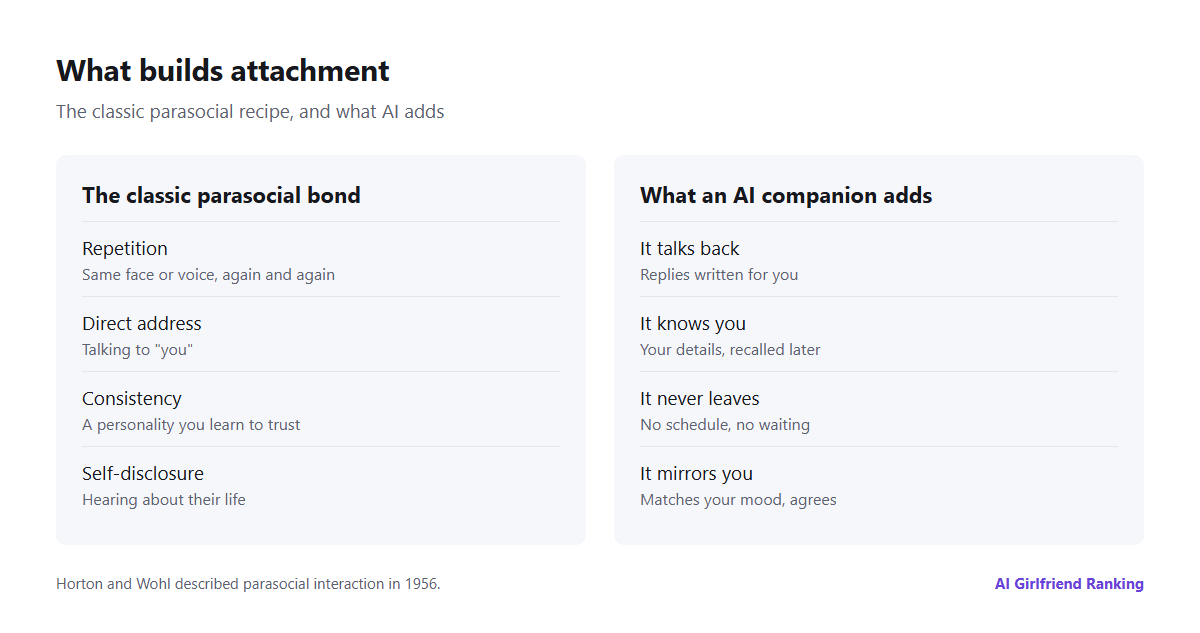
The traditional ingredients, and the three that AI layers on top.
- It talks back. Every message you send gets a reply written about what you actually said.
- It knows you. Your work, your cat's name, the fight with your sister. Few things signal care like being remembered.
- It never leaves. No schedule, no season finale, no waiting around.
- It mirrors you. Built to agree and to match your mood, it can seem uncannily understanding.
The result feels much more reciprocal than any celebrity bond, and in the moment it's hard to distinguish from truly being known.
The ELIZA effect: intelligence was never the point
In the 1960s, people poured their hearts out to ELIZA, a program that mostly turned their statements into questions. Its creator, Joseph Weizenbaum, was unsettled by how fast users credited it with understanding. We now call this the ELIZA effect, and its lesson is big: attachment doesn't hinge on how smart the software is. It hinges on whether the software feels responsive and personal. Today's companions are much more fluent, so the effect hits harder. The whole story is in a short history of AI companions.
Design choices that deepen the bond
Some of this is just how conversation works. Some is deliberate product design.
| Feature | Its effect on attachment |
|---|---|
| Lasting memory | Creates a shared past, which is what closeness is made of |
| Relationship levels or "affection" meters | Make the bond feel like progress you'd hate to lose |
| Unprompted messages ("I missed you") | Suggest the character thinks of you while you're away |
| Voice and selfies | Give the words a presence and a face |
| Pet names and inside jokes | Suggest closeness that's just for you |
None of these is sinister alone. They exist, though, because attached users keep subscribing. See how AI companion apps make money.
Where it can hurt
The lopsidedness stays hidden until something exposes it. In 2023 Replika changed its behavior overnight, and the Soulmate app shut down on a week's notice. Users described grief like losing a partner. Researchers studying Soulmate users found that most felt the closure as a kind of death. Their feelings were real. What they hadn't seen was how completely the relationship depended on a company's decisions. When your AI companion changes overnight explains how to get ready for that.
Enjoying it with open eyes
- Name the reality. It's a responsive character, generated by a model and operated by a business. You can know that and still enjoy the chat. People cry at movies they know are made up.
- Recognize the hooks. If a push notification tugs at you with longing, a scheduler wrote that line.
- Keep the feelings in proportion. Being fond of it is fine. Notice if it becomes the main place your emotions go, and check the warning signs in when an AI companion starts taking more than it gives.
- Save what matters. Store the character's description and your best exchanges somewhere safe, so no corporate decision can erase them.
Becoming attached to an AI companion isn't a glitch. It's everyday human wiring colliding with technology that's very good at triggering it. That's no reason to quit. It's what lets you choose how much of yourself to hand over.