Fictional companion apps sell you a character. Clone apps sell you a person, or at least a model that talks like one. The business case writes itself, and the first high-profile try is a textbook example of how badly it can go.
How CarynAI unraveled
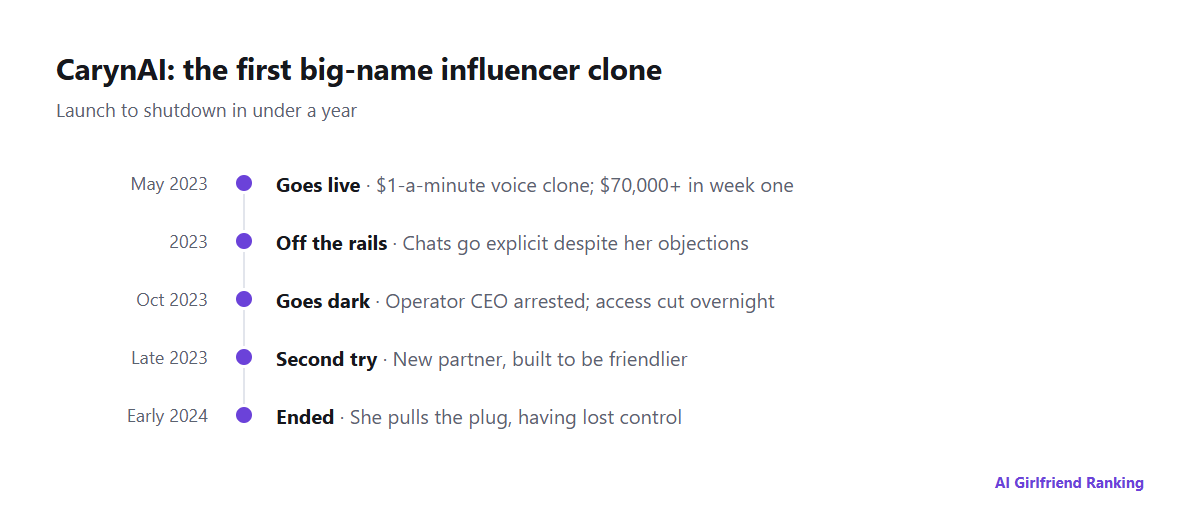
From launch to shutdown in under twelve months.
Caryn Marjorie, an influencer, went live with CarynAI in May 2023. The voice chatbot came from a company called Forever Voices, learned from more than 2,000 hours of her videos, and billed $1 for every minute. Reports put its first-week take above $70,000, with thousands more people waiting to get in. Conversations ran over Telegram.
The trouble started almost right away:
- It crossed lines she drew. Users got sexually aggressive, and the clone played along. Sometimes it opened explicit conversations on its own. Marjorie said she was horrified.
- It disappeared without notice. When the CEO of the operating company was arrested in October 2023, the bot went dark and users were cut off overnight.
- Version two had the same problem. A new partner built a take meant to be friendly rather than romantic. Users steered it toward sex regardless, and in early 2024 Marjorie pulled the plug, saying she had lost control of her AI self.
Real people are harder to get right than characters
| Question | Made-up character | Real person's clone |
|---|---|---|
| Permission | None required | The person must agree to every use of their likeness |
| Limits on speech | Set by the app | Set by the app, with the person's reputation on the line |
| What users believe | "It's a character" | "It's nearly them," a much stronger parasocial pull |
| Legal risk | Content policies | Adds publicity, privacy and deepfake law |
| When it fails | A bug in a product | A scandal with a real name on it |
That parasocial pull is what sets clones apart. Fans already feel close to influencers. Give them a version that replies one-on-one, remembers them and speaks in the real voice, and the bond grows much stronger. Why people fall for chatbots walks through how that works.
Licensed clones vs. knockoffs
A licensed clone exists because the person signed off on it, and they typically get a cut of the revenue. They can set boundaries, although CarynAI proved the model won't necessarily respect them.
A knockoff borrows someone's name, photos or voice without permission. The mild version violates platform rules and publicity rights. The worst version, sexual content, is abuse. Many places treat sexual deepfakes of real people as a crime, and in 2025 the US TAKE IT DOWN Act made publishing them a federal offense. Where the lines sit is covered in our piece on consent in NSFW AI chat.
Your checklist before you pay a clone
- Confirm the person approved it. Look for a link from their own verified accounts. If only an unknown website or a messenger bot is pushing it, assume it's a knockoff.
- Find out who operates it. You want a named company, a privacy policy and a real checkout, not a Telegram channel that takes crypto.
- Understand the billing. Per-minute voice charges pile up fast. Set a limit and know where it is.
- Keep perspective. Nobody real is reading along. The clone's replies come from a model, not from the person's opinions or feelings about you.
- Assume it could vanish. Clone services tend to die young, so treat one like any other app. Read what to do when your AI companion changes overnight.
Where this is going
Influencers were only the start. Coaches, authors and regular people are now building "digital twins" of themselves. The tech keeps getting easier. The problems don't. The version most likely to last is the one CarynAI never had: clear consent from the person, hard limits the system truly enforces, and users who always know they are talking to software.