Ask why people give up a journal after a week and the answer is nearly always the same: an empty page. An AI companion never hands you one. It asks you something. That's the entire pitch for using one, and it comes with a catch.
The science of writing it out
In the 1980s, psychologist James Pennebaker had people spend 15 to 20 minutes over several days writing about the most upsetting things they'd been through. A control group wrote about neutral subjects. The first group later reported fewer doctor visits and a better mood. Hundreds of follow-up studies came after. The effects are modest and uneven, but the pattern keeps showing up: turning an experience into words, and above all making sense of it, tends to help.
Note that second part. The gain seems to come less from venting and more from building a story: working out what caused what, sorting your feelings, and standing a bit farther back from the event.
What the companion brings
- An opening question. "What was the best and worst part of today?" beats a blank screen.
- Follow-ups. A good one moves you from what happened to why it mattered.
- Exercises on request. Ask for a gratitude list, a worry sort or a weekly review and it will walk you through it.
- A hook for the habit. Already open the app every night? Bolting five minutes of reflection onto that is painless.
What it can cost you
- Privacy. Paper stays with you. A companion app keeps your writing on its servers. Read what your AI girlfriend app knows about you before you pour it all in.
- The thinking itself. If the AI sums up your feelings for you, you've read a summary. You haven't worked anything out.
- Pushback. Companions lean toward comfort and agreement. "You didn't do anything wrong" feels great, and it ends the reflection right where it should begin.
Prompts that produce reflection, not reassurance
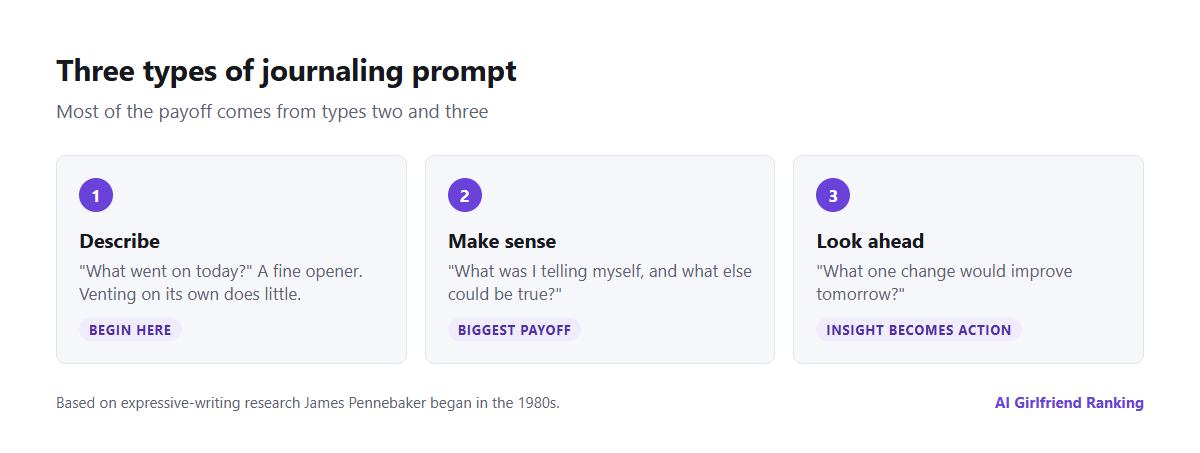
Spend your time on the second and third types. That's where the payoff is.
Open each session with an instruction that sets the tone:
(OOC: Tonight, be my journaling partner, not my cheerleader. One question at a time. Don't tell me what I feel or whether I was right. Keep replies short.)
Then choose from this list:
| What you want | What to tell the AI |
|---|---|
| Work through a rough day | "Ask what happened, then what I told myself about it, then what else might be true." |
| Sort out a worry | "Help me split today's worries into the ones I can act on this week and the ones I can't." |
| Spot patterns | "Ask what felt the same as last week and what didn't." |
| Plan tomorrow | "Ask what single thing would improve tomorrow and what could get in the way." |
| Real gratitude | "Have me name three specific good moments and why each happened." |
| Cool down after a fight | "Make me retell it from the other person's side, using their words." |
An evening routine that takes five minutes
- Start with the tone instruction above, or save it as a note in the character's settings.
- Answer one prompt in full sentences for three or four minutes.
- Write the final line yourself. One sentence about what you get now that you didn't when you started.
- Stop. Don't let it slide into an hour of chat. The reflection is the point, and chatting afterward is a different activity.
Keep the touchy stuff elsewhere
Many people settle on a split. The AI handles structure and questions. Anything with other people's names, health details, or things you'd never want a stranger to read goes in a private notes file or a paper journal. At the end of the week, copy your one-line takeaways into the private one.
When a journal isn't enough
Writing eases everyday stress and helps you make sense of events. It doesn't treat depression, trauma or thoughts of self-harm, and an AI journaling partner isn't a therapist. An AI companion is not a therapist explains the difference. If your entries keep circling back to hopelessness, talk to a real person. In the US, call or text 988 any time. Elsewhere, findahelpline.com lists free services by country.