"Training" a companion makes it sound like software slowly learning your tastes, the way a puppy would. The truth is messier. A few levers change behavior instantly, some change it slowly for everybody, and some mostly make you feel involved.
What shapes any given reply
The model writes each reply from whatever it can see right then, the mechanism laid out in how an AI companion writes its replies:
- The character's description and settings.
- Saved memories and summaries pulled in for this chat.
- The recent conversation itself.
- The base model, as the company last updated it.
Your feedback counts only to the degree that it alters one of those four.
Levers ranked, strongest first
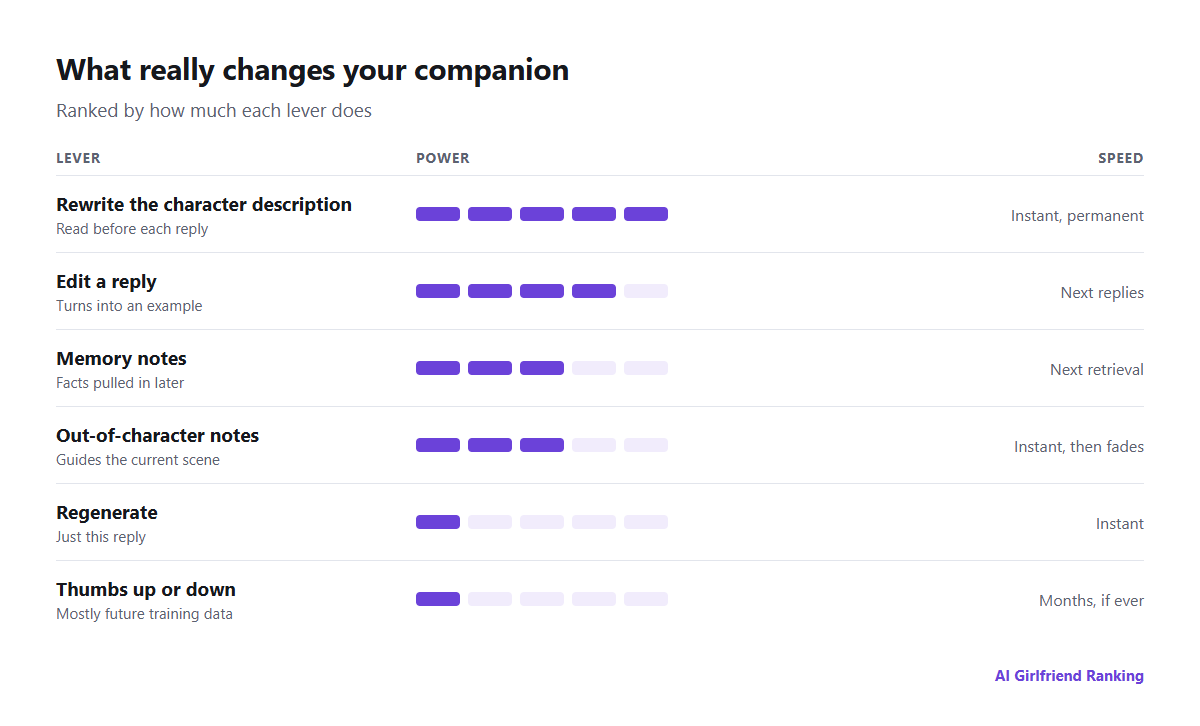
Rewrite what the model reads. Its feelings toward you aren't the target.
| Lever | What it touches | Speed | Power |
|---|---|---|---|
| Rewriting the character description | Instructions read ahead of every reply | Instant | Strong and permanent |
| Editing one of her replies | The chat the model copies from | Following replies | Strong while it's in view |
| Memory notes | Facts pulled into future chats | Next time they're retrieved | Strong for facts, weak for style |
| Out-of-character notes | The scene in progress | Instant | Fades as the chat grows |
| Regenerating | That one reply only | Instant | Nothing past that reply |
| Ratings (thumbs, stars) | Usually training data for future models | Weeks or months, if ever | Weak for your character |
Edit her, don't argue with her
Complaining in character ("that's not like you") seldom works, since the scolding becomes part of the chat the model imitates. Rewrite her reply into what she should have said and the model has a correct example to follow. Where an app allows edits, this is the habit worth building first.
Style goes in the description, facts go in memory
- Style covers tone, sentence length, humor and how affectionate she is. It belongs in the description, since it has to apply to every reply. Our character builder guide explains which fields count.
- Facts such as your job, your dog's name or last week's events belong in memory, which gets pulled in when relevant.
Mixing them up backfires. Style notes in memory get retrieved unevenly, and long fact lists in the description push out personality.
What ratings are for
In most apps, ratings feed the company's data for improving its models, usually across every user. That can be worthwhile, since you're helping later versions, but it's no direct line to your own character. A few apps say ratings tune your companion in particular. Even so, the shift is gradual and nowhere near as strong as a rewritten description.
If privacy matters to you, read the policy: rating a reply may flag that conversation for review or training, which is a trade-off. See who reads your AI companion chats.
A weekly tune-up
- Jot down two things you liked and one that bugged you this week.
- Turn the annoyance into a positive instruction in the description ("She answers in short, dry sentences," not "Don't ramble").
- Put any important new facts into memory.
- Open a fresh chat if the old one has wandered. Long conversations build up habits, as personality drift describes.
No, a companion won't get to know you like a person would. It does read you on every turn, though, via its description, its memory and your latest words. Alter that input and you alter the character.