Before you trust any AI companion number, ask three questions: who did the counting, what exactly did they count, and where. Mobile app data cannot see web-only services. Survey answers shift with the wording of the question. And a market "forecast" is frequently a sales pitch.
The main numbers at a glance
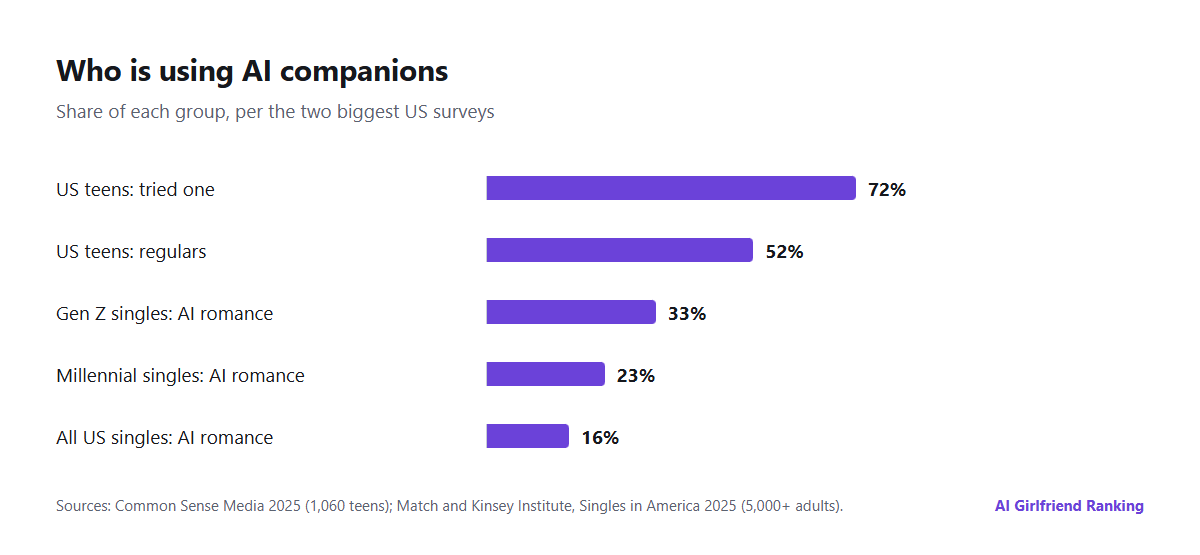
How many people in each group have used AI companions, according to the two biggest US surveys.
| Metric | Number | Who published it | What is inside the number |
|---|---|---|---|
| All-time companion app downloads | 220 million | Appfigures, July 2025 | Counts the App Store and Google Play only |
| In-app revenue, January to June 2025 | $82 million | Appfigures | Phone app stores; web sales left out |
| Forecast in-app revenue for all of 2025 | Over $120 million | Appfigures | A projection, mobile only |
| Companion apps currently earning revenue | 337 | Appfigures, mid-2025 | 128 of these came out in 2025 |
| Revenue captured by the top 10% of apps | 89% | Appfigures | Very top-heavy market |
| US teens who have tried an AI companion | 72% | Common Sense Media, 2025 | Survey of 1,060 teens, ages 13 to 17 |
| US teens who are regular users | 52% | Common Sense Media, 2025 | A few times a month or more |
| US singles who have engaged with AI as a romantic companion | 16% | Match and Kinsey Institute, 2025 | 5,000+ adults; read the caveat below |
| Gen Z singles, same question | 33% | Match and Kinsey Institute, 2025 | |
| Singles who call an AI partner cheating | 40% | Match and Kinsey Institute, 2025 |
A caveat on the Match number: coverage of that survey points out that "engaging with AI as a romantic companion" may also include people who simply had AI polish a dating profile or draft messages. It is not only people with an AI partner, so read it as a ceiling.
Why people turn to them
The Common Sense Media teen survey found:
- One in three teens used companions for social or relationship reasons: practicing conversations, getting emotional support, roleplay and romance.
- 39% of teen users said skills they rehearsed with AI carried over into real-life situations.
- 31% said talking to AI felt as good as or better than talking to friends, yet 80% still spent more hours with real friends.
In the Match survey of singles who have an AI partner, 45% said AI made them feel more understood, and 44% said its emotional support beat what they get from people.
A small market with a few big winners
Appfigures counted more than $1.4 billion of consumer AI app spending in 2024, so companions are a modest slice of it. They are growing quickly, though: downloads in the first half of 2025 rose 88% year over year, and revenue per download more than doubled. A few apps pull in nearly all the money, while most of the hundreds in the category earn very little.
Mobile figures leave out two things:
- Web subscriptions. Many adult-oriented apps sell mostly or only through their own sites, partly because of app store content rules. That income never shows up in store data. More on that in browser or app store.
- General-purpose chatbots used as companions. Some people talk to ChatGPT, Claude or Grok the way they would a companion. Research from OpenAI and MIT found that emotional use of ChatGPT is uncommon overall, but clusters among a small group of heavy users.
Numbers to treat with suspicion
- "The AI companion market will hit $X billion by 2030." These forecasts differ by orders of magnitude, and they usually come from companies that sell research reports.
- User counts quoted by the apps themselves. A signup is not an active user.
- Per-character engagement claims, like minutes per day, which tend to come from blog posts with no source.
- Percentages with no base. "40% of users" of what group, asked how?
Where to keep up
Appfigures and similar app-intelligence firms publish category updates, while Common Sense Media and the Match/Kinsey Singles in America study run their surveys again over time. Academic work on wellbeing is rounded up in do AI companions help mental health. For how the category earns its money, see how AI companion apps make money.